episode 3 of 12 7:46 10 scenes book chapter 4
Families across genres
Group games by their mechanics instead of their genre and families appear: series that stay together, a sequel that moved, and odd couples like Papers, Please and Princess Maker 2. How the families are drawn, how far they match genre, and where they fall apart.
 play · 7:46
in the book
the chapter this episode followschapter 4 3,817 words about 17 min 121 records
Families
In this chapter: What the two games share · How the families are drawn · Families that cross genres · Series and descendants · Reading a family · How much genre explains · Where the method is weak · Exercise: place a game.
games in this episode
44 named in the narration, 4 more on screen

Papers, Please
A border inspection game in which the player checks entrants' documents against daily-changing rules on a timed shift and spends the wages on a family's rent, food, and heat.
on screen 2:31

Princess Maker 2
A raising sim in which the player, as a father figure, schedules a daughter's training, part-time jobs, rest, and adventures from age 10 to 18, and her accumulated attributes decide one of 74 endings.
on screen 2:31
Job Simulator
A room-scale VR comedy set in a museum run by robots, where the player performs parodied office, kitchen, store, and garage tasks by grabbing and manipulating physics objects.
on screen 2:59
The Incredible Machine
A Rube Goldberg puzzle game in which the player places supplied parts such as balls, ropes, pulleys, belts, and animals into a level so that a deterministic physics run completes a simple goal.
on screen 3:01
House Flipper
A first-person renovation sim in which the player cleans, paints, demolishes, and furnishes rundown houses, then sells them to buyers whose bids depend on how well the house fits their needs.
on screen 3:08
PowerWash Simulator
A first-person cleaning sim in which the player power-washes vehicles and buildings, choosing nozzles and soaps to strip dirt layers until every part reports clean.
on screen 3:08
Stardew Valley
A farming and life sim in which the player restores an inherited farm over four 28-day seasons, splitting a daily energy budget among crops, animals, mining, fishing, and friendships with Pelican Town's residents.
on screen 3:18
Harvest Moon
An early farming sim for the Super Famicom in which the player has two and a half years to restore an inherited farm through daily crop watering, livestock care, and courting one of five eligible women.
on screen 3:20
Black & White
A god game in which the player wins villagers' belief through miracles, help, or fear while training a giant creature whose behavior is learned from the player's rewards and punishments.
on screen 3:28

Europa Universalis IV
A real-time-with-pause grand strategy game in which the player directs one of over 500 nations from 1444 to 1821 through monarch-point spending, trade-node competition, colonization, diplomacy, and war on a province map.

Sid Meier's Civilization
A turn-based 4X game in which the player guides a civilization from 4000 BC toward the space age by founding cities, researching a technology tree, building one-per-world wonders, and competing with rival civilizations by diplomacy or war.
on screen 3:45
Stellaris
A real-time-with-pause space 4X and grand strategy game in which the player designs a species and empire, expands across a procedurally generated hyperlane galaxy from 2200, manages pops, jobs, ethics-based factions, and research card draws, and faces late-game crises.
on screen 3:46
RollerCoaster Tycoon
An amusement park management game in which the player builds rides and custom coasters piece by piece, rated for excitement, intensity, and nausea, to satisfy guests with individual preferences and meet scenario goals.
on screen 3:50
Theme Hospital
A hospital management game where the player builds rooms, hires and trains staff, and routes patients with comic diseases through diagnosis and treatment to meet level goals.
on screen 3:50
Game Dev Tycoon
A game-studio business sim where the player picks topic, genre, and platform for each game, splits development effort across design and technology focus areas, and lives or dies by review scores across the history of the industry.
on screen 3:53
Dwarf Fortress
A colony sim in which the player directs a fortress of autonomous dwarves inside a procedurally generated world whose history, geology, fluids, bodies, and minds are all simulated.
Oxygen Not Included
A side-view colony sim in which a few duplicants survive inside an asteroid where every tile holds an element with mass and temperature, so air, liquids, heat, and germs flow through the base.
on screen 4:11
AI Dungeon
A text adventure in which a large language model continues the story after each player input, so actions, dialogue, and world facts the player types are improvised into narration rather than resolved by authored rules.
on screen 4:20
Infinite Craft
A browser crafting game in which combining any two elements yields a new element whose name and emoji a language model generates on first request and a shared database then fixes for all players.
on screen 4:30

Elite Dangerous
An online space sim set in a 1:1 procedurally generated Milky Way where players trade, fight, mine, and explore while a server-side background simulation shifts faction control from aggregate player actions.
on screen 4:32
The Sims 4
The fourth mainline Sims game, built around a dominant emotion computed from moodlets, three-trait personalities with aspiration rewards, multitasking, room-based building, and an in-game Gallery for sharing creations.
on screen 4:36
Offworld Trading Company
A real-time economic strategy game on Mars where companies claim resource tiles, refine goods for a shared market whose prices move with every trade, and win by buying out every rival's stock.
on screen 4:44
Railroad Tycoon
A railroad business sim in which the player lays track, builds stations, schedules trains to meet regional supply and demand, and battles rival barons through the stock market.
on screen 4:56
Satisfactory
A first-person 3D factory automation game in which a pioneer taps infinite resource nodes on an alien planet and connects machines with belts, pipes, trains, and drones to deliver project parts to FICSIT's Space Elevator.
on screen 5:17
Against the Storm
A roguelite city builder in which each settlement must fill a reputation gauge before the Queen's impatience runs out, balancing three villager species' needs while opening dangerous forest glades under a recurring blightstorm.
Frostpunk 2
The sequel to Frostpunk, in which the Steward builds whole districts on the frost and must pass laws through a council of 100 faction delegates while faction tension can escalate into civil war.
on screen 5:36
Conway's Game of Life
A zero-player cellular automaton on an infinite square grid in which each cell lives or dies by the B3/S23 neighbor-count rule, producing gliders, oscillators, and universal computation from a seeded pattern.
on screen 6:37
The Oregon Trail
An educational turn-based travel sim in which the player buys supplies and sets rations for a wagon journey to Oregon while random events, weather, and illness threaten the party.
on screen 6:47
Timberborn
A city builder for beaver colonies in which simulated water flows over terrain, recurring droughts and toxic badtides cut or poison it, and players dam, channel, and store water while building upward.
on screen 6:55
also on screen · 4 games
mechanics in this episode
14 named in the narration, 85 more on screen
Conveyor transport
Items move continuously on belts or lanes with throughput limits, splitters, merges, and priorities.
Megaproject sink
A terminal construction absorbs very large quantities of produced goods in staged phases and serves as the long-run goal and output sink of a production game.
Crop cultivation
Planted crops progress through growth stages over days or seasons depending on water, soil, and season, then are harvested.

Creature care
The player directly feeds, cleans, and plays with a creature whose needs decay; neglect causes sickness, stunted growth, or death.
on screen 3:34
Interest groups
Factions within a polity have clout and preferences over policies, and their approval gates what the player can do.
Policy toggles
Enactable laws or policies change simulation rules with explicit tradeoffs.
Structural integrity
Structures carry support values or loads propagated from the ground, and elements that lose support or exceed their limits collapse.
on screen 3:48
Staff hiring and rosters
The player hires individual staff with skills, traits, and wages to operate a facility or team.
on screen 3:50

Mood and breakdowns
Mood aggregates needs, memories, and environment, and crossing thresholds triggers mental breaks or inspired performance.

Equity and buyouts
Companies issue shares whose price tracks performance, and players buy them for profit or accumulate a majority to take control of rivals.
on screen 4:44

Turn structure
The simulation advances in discrete turns, each divided into ordered phases in which players decide and the world then resolves.
also on screen · 85 mechanics





























shorts from this episode
1 · under a minute each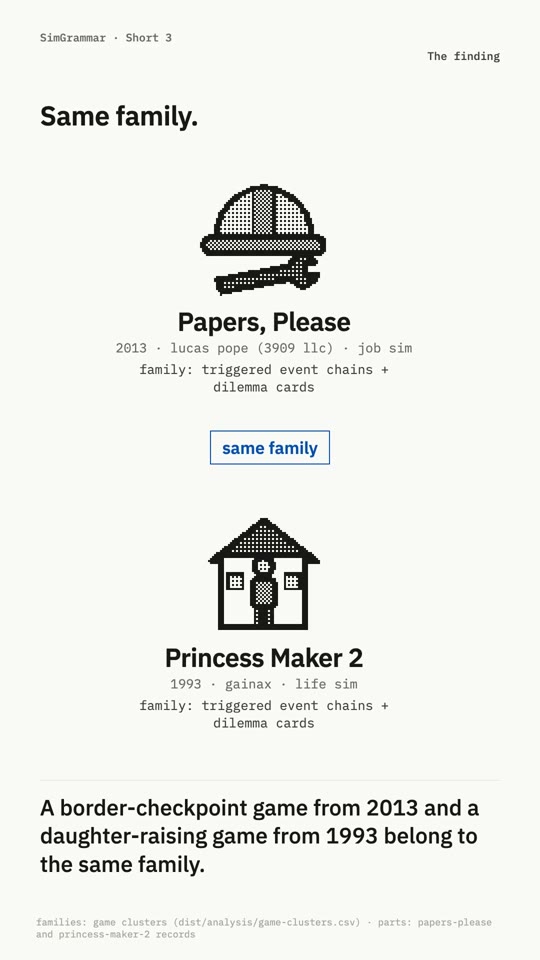 play · 0:36
short 3 0:36 from chapter 4 · episode 3
A border post and a daughter
A border-checkpoint game from 2013 and a daughter-raising game from 1993 belong to the same family.
transcript
every number checked against the dataset when the episode was renderedread the transcript, scene by scene · 10 scenes
Cold open
In Factorio, the power is short, so every machine on the grid slows by the same fraction, and the smoke from your furnaces is feeding the nest that is about to attack you.
In Anno 1800, a street of houses is waiting for canned goulash from another island, on a ship that is late. Both games run on production chains. The dataset puts them in different families.
Same chain, different games
Factorio and Anno 1800 share six mechanics. The two most common are production chains, in 38 catalog games, and building placement, in 77.
The parts each game has alone are rarer, and they decide what it feels like. Factorio is about throughput: belts, power, pollution, and enemies that evolve with the pollution you make. Anno is about demand: five tiers of residents whose needs decide whether their houses advance, and goods shipped between islands to meet them. Each tier also staffs its own factories, so when workers move up to artisans, a workers' chain loses its labour.
How the families are drawn
To group games, the dataset turns each one into its list of mechanics. Core parts count double. Each part is weighted by how rare it is, so two games that share a rare part count as much closer than two games that share a pause button. Production chains, in 38 games, count for little; conveyor belts, in 9, count for a lot. Then the build joins the closest games, and the closest groups, until it has a chosen number of clusters.
Factorio lands with Satisfactory, shapez 2, Dyson Sphere Program, and Captain of Industry. Anno 1800 lands with Manor Lords, Banished, Caesar III, and Pharaoh.
How many families
The build re-clusters 1000 random subsets of the games and checks how well each agrees with the full result. The stated rule takes the smallest number of clusters whose average agreement reaches 0.75. When it was last applied, that was 24. On today's data the same rule picks 19.
The curve is that flat. So the number of families is a weak fact, and this series only claims pairings that survive the resampling. When it says two games belong together, they share a cluster in at least 0.9 of those subsets. When it says they stand apart, in at most 0.1. Each claim is checked every time the dataset is built. By a separate measure, 15 of the 24 clusters keep their shape across the resampling, and the rest shift as games come and go.
Odd couples
Papers, Please is about checking passports at a border. Princess Maker 2, from 1993, is about raising a daughter from ten to eighteen. They share a family. In both, time comes in fixed slots, money is tight, and authored events keep arriving. At the border you are paid per correct decision, mistakes arrive as citations by fax, and the wages go to rent, food, and heat for your family. A shift at the border and a month of your daughter's life are the same kind of budget.
Job Simulator belongs with Besiege and The Incredible Machine, because nearly every object in reach is a physics object you can grab, throw, or combine. Two other job sims, PowerWash Simulator and House Flipper, stand apart in a family of their own, built on tools and contracts.
Farming Simulator lands with the racing games, and apart from Stardew Valley and Harvest Moon. Its farm is a fleet of more than four hundred licensed machines doing field work in order, and the skill is operating them.
Black & White is a god game, and it stands apart from Populous, the god game that started the genre. The creature you train puts it with the virtual pets and with Creatures.
Tropico 6 is filed as a city builder, and it stands apart from SimCity. Its family is the rulers: Europa Universalis IV, Civilization, and Stellaris, held together by stability, policy choices, and interest groups.
Theme Hospital, RollerCoaster Tycoon, and Game Dev Tycoon hold together on hiring staff, research, and crowds with preferences. Their patients and visitors have needs, as The Sims' characters do, and they still stand apart from the life sims. The player is running a business that serves a crowd.
The colony sims hold together, RimWorld with Dwarf Fortress and Oxygen Not Included, and so do the life sims, The Sims with Paralives. The two groups share a cluster in most resamplings, less often than either holds together.
And inZOI lets typed prompts steer its characters through an on-device model, but its needs-driven core is Sims-style, so it sits with The Sims and apart from AI Dungeon and Infinite Craft.
Series and descendants
Series stay together. SimCity with SimCity 4, The Sims with The Sims 4, and Elite with Elite Dangerous, thirty years apart, on generated star systems, trade, and a ship you fly yourself.
The method also finds descendants with different names. Offworld Trading Company, from 2015, shares a family with M.U.L.E., from 1983, in every resampling. Its designer names M.U.L.E. and Railroad Tycoon as inspirations. Prices move with every purchase and sale, and you win by buying up your rivals' shares, a mechanic the catalog first records in Railroad Tycoon. Those old trading games keep a weaker tie to the factory games. Factorio shares a cluster with Railroad Tycoon in about half the resamplings, and with Satisfactory in all of them.
The sequel that moved
Frostpunk is the one series in the catalog that splits. Frostpunk is a survival city builder around a single coal generator. Temperature falls on a schedule, and the laws you sign trade your people's welfare for output. Its nearest neighbour is Against the Storm.
Frostpunk 2 builds districts instead of buildings and passes laws through a council of a hundred delegates. Most laws need 51 votes. Broken promises anger factions, and faction tension can end in civil war. The developer describes social survival as a bigger threat than the cold. Its parts put it with Tropico 6 and Europa Universalis IV, and it shares a cluster with the first game in fewer than half of the resamplings.
How much genre explains
Knowing a game's family tells you a good deal about its genre: normalized mutual information is 0.74, against 0.42 when the labels are shuffled at random. By a stricter score, the adjusted Rand index, where 1 would mean the families reproduce the genres exactly, agreement is only 0.37. And 20 of the 24 clusters mix genres. Mechanics recover where games came from far better than chance, and they still cross genre lines often.
A game's family says what it is built from, and that is the part a designer can borrow.
Limits
Games with very few mechanics look alike by what they lack: the Game of Life has only 3 mechanics, one of them the turn structure it shares with Hamurabi and The Oregon Trail, so it clusters with them. Some clusters fall apart under resampling: the one that holds Frostpunk, Plague Inc., Timberborn, and FTL changes from subset to subset, and only Frostpunk and Against the Storm stay together. The clustering also sees which parts a game uses and ignores how they are tuned, and every decomposition so far was written by one model rater. A second rater is the next test of these families.
Close
Take a game you know, circle its rare parts, and find the catalog games that share two or more. That is its family, whatever its genre. Then pick the member that looks least like your game on its store page, read how it handles the part you share, and write down one thing your game could take from it.
RimWorld and Dwarf Fortress share a family in every resampling, and both carry the catalog's top emergence score. Next episode: why the deepest systems are the hardest to read.