episode 4 of 12 7:03 10 scenes book chapter 5
Why deep systems are hard to read
A flooded fortress in Dwarf Fortress shows a chain of causes the player never sees. Mechanics that produce more variety are rated harder to read and harder to balance, and designers answered with mechanics that simulate nothing and only show what the others hold.
 play · 7:03
in the book
the chapter this episode followschapter 5 3,966 words about 17 min 39 records
Depth costs legibility
In this chapter: Two scores · What the scores show · Readable rules, unreadable results · Harder to balance · Expensive and hidden · Hard reads · Mechanics that own nothing · Hidden on purpose · Choosing a point on the slope · Exercise: trace a collapse.
games in this episode
12 on screen, in order of appearance
Dwarf Fortress
A colony sim in which the player directs a fortress of autonomous dwarves inside a procedurally generated world whose history, geology, fluids, bodies, and minds are all simulated.
Conway's Game of Life
A zero-player cellular automaton on an infinite square grid in which each cell lives or dies by the B3/S23 neighbor-count rule, producing gliders, oscillators, and universal computation from a seeded pattern.
on screen 2:42

EVE Online
A single-universe space MMO in which players mine, manufacture, trade, and fight in ships that are destroyed for good, inside a player-made economy and a galaxy of high-, low-, and null-security space where player alliances claim sovereignty.
on screen 3:02
Oxygen Not Included
A side-view colony sim in which a few duplicants survive inside an asteroid where every tile holds an element with mass and temperature, so air, liquids, heat, and germs flow through the base.

Cities: Skylines
A city builder in which road-following zones, agent citizens who route to work along computed paths, district policies, and player-drawn transit lines make traffic flow the central design problem.
on screen 4:15

RollerCoaster Tycoon
An amusement park management game in which the player builds rides and custom coasters piece by piece, rated for excitement, intensity, and nausea, to satisfy guests with individual preferences and meet scenario goals.
on screen 4:44

Victoria 3
An economic grand strategy game set from 1836 to 1936 in which the player industrializes a nation by building production chains, passing laws through interest-group politics, and pursuing diplomatic plays while population strata respond through wages, needs, and radicalism.

Lemonade Stand
A 1973 educational business sim in which the player runs a lemonade stand for 12 days, setting glasses made, advertising signs, and price against a daily weather report.
on screen 4:58

mechanics in this episode
5 named in the narration, 26 more on screen
Memories and thoughts
Events create itemized, time-limited mood modifiers or lasting memories that shape later behavior.

Stress accumulation
A slow per-agent stress stock integrates negative experiences scaled by personality and, as it crosses levels, triggers breaks or lasting changes.
Traffic congestion
Trips route over a capacitated network; volume beyond capacity raises travel time and delays services and deliveries.
on screen 4:41


History chronicle
The game records significant simulation events into a structured history that players can browse and other systems can reference.
also on screen · 26 mechanics
















shorts from this episode
1 · under a minute each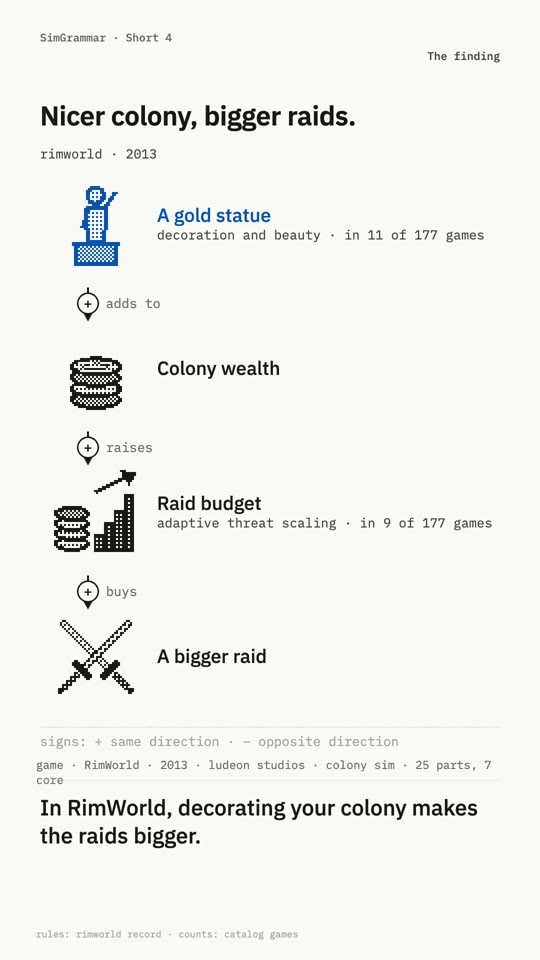 play · 0:36
short 4 0:36 from chapter 5 · episode 4
Decorating makes the raids bigger
In RimWorld, decorating your colony makes the raids bigger.
 Decoration and beauty
transcript
every number checked against the dataset when the episode was renderedread the transcript, scene by scene · 10 scenes
Cold open
The plan was a cistern under the dining hall: dig to the river, build a floodgate, then cut the last tile. The miner cut the last tile first. Water in Dwarf Fortress moves tile by tile, one to seven levels deep, downhill through every opening it can find. By the time you wall off the tunnel, the bedrooms are full and several dwarves have drowned in their beds.
The chain you cannot see
The fortress looks fine afterward. What you can't see is a number each survivor carries: a stress value that runs from minus a million to plus a million. Grief adds to it, scaled by personality, and strong memories keep adding to it whenever they come back. Past ten thousand, twenty-five thousand, and fifty thousand, dwarves start throwing tantrums, falling into depression, and wandering off [1].
Months later the metalsmith smashes a table in the dining hall, and everyone who watches gets a new unhappy memory. One of them lost a brother in the flood. By spring the fortress can't feed itself.
Every link in that chain is simple. Water flows downhill. Grief adds stress. Tantrums spread it. The chain is hard to see because it runs through months of game time and a number the game never puts on screen.
Two scores
The dataset behind this series scores every mechanic on six scales. Two matter here. Legibility asks how easily a player builds an accurate picture of the mechanic from play. A 2 means you need a wiki. A 5 means it's clear at a glance. Emergence potential asks how much unscripted variety the mechanic produces when it's connected to others. A 4 means it often sets off chains of consequences across systems.
Dwarf Fortress's stress system scores 3 and 4. Its simulated history, which can run a world forward thousands of years before you arrive, scores 2 and 5. The pause button scores 5 and 1.
One model rater assigned every one of these scores, reading each mechanic's record against the anchors, and nobody has rated them independently yet. So the patterns in this episode are a consistent reading of the design knowledge in the records. They aren't measurements of players.
The slope
Plot all 199 mechanics and the cloud leans. The more variety a mechanic produces, the harder it's rated to read. The 14 mechanics at the bottom of the emergence scale average 4.4 for legibility. The 44 at 4 or 5 average 3.1.
Part of that lean is built in. Overlays and pause buttons generate nothing by themselves, so they sit at the bottom of the emergence scale, and they're easy to read because reading them is their job. Take those two families out and the relationship weakens, but it keeps its direction.
Rules you can read
Conway's Game of Life has one rule, and it fits on a line. A dead cell with three live neighbors comes alive. A live cell with two or three survives. That's all of it, and you still can't read a pattern's future from it. This five-cell shape keeps changing for 1,103 generations before it settles.
EVE Online is the same at the scale of a society. Players make nearly every ship, destroyed ships are gone for good, and every price history is public. The rules of one trade are simple. The economy those trades add up to was complicated enough that the developer hired an economist in 2007 to watch it.
Harder to balance
Mechanics that produce more of it are rated harder to balance, and that's the strongest relationship among all six scales.
Before each raid, RimWorld computes a budget of raid points from your colony's wealth and your colonists, then multiplies it by a few factors, one of which drops after colonists die [2]. None of that is on screen. Players who look it up on the wiki learn to keep their wealth down: they skip the statues and the fine furniture so the raids stay small. The mechanic scores 2 for legibility and 4 for tuning difficulty.
Expensive and hidden
Legibility also falls as compute cost rises. The expensive mechanics tend to be fields and crowds, and you can't watch a field the way you watch one colonist. In Oxygen Not Included every tile of the asteroid holds one element with a mass and a temperature, and gases spread and sort themselves cell by cell. Without overlays, all of that is tinted tiles.
The original SimCity has no cars. A zone looking for a destination takes a random walk of up to 30 steps along the roads, and each success adds to a traffic number on the map [3]. Cities: Skylines simulates every vehicle, so you can watch a jam form. Players could see the jams and still not understand them. Cars crowd into one lane while the next one sits empty, and stuck cars disappear by default, which hides the real problem. Traffic congestion scores 2 for legibility.
Mechanics that own nothing
Designers answered with a family of mechanics that simulate nothing. They read state other mechanics own, and they show it. The dataset has 10 of them, and they're old. Hamurabi's steward reported the harvest in 1968. Lemonade Stand gave you a weather report every morning in 1973.
Overlays recolor the map by one hidden field. Causal tooltips let you hover a number and see the named terms that add up to it, and hover the terms inside that list in turn; Paradox's strategy games are built on them [4]. Inspection panels open one agent's head. RollerCoaster Tycoon gave every guest a stream of thoughts, so you could click a guest, read that the drinks cost too much, and change the price. Chronicles record what happened: Dwarf Fortress's Legends archive can run to about a gigabyte for a long history [5].
Each of these fails in its own way. A color ramp that rescales itself makes a small problem look as red as a big one. Tooltips grow into walls of numbers late in a game. An inspection panel that shows what a character wants but not how it decided still leaves its behavior looking random.
Choosing a point
Dwarf Fortress was built to break each system into parts and base each one on something real [6]. It has more mechanics than any other game in the catalog, 30. The stress numbers at the start of this episode come from the community wiki, because the game doesn't show them. RimWorld took several of the same systems and chose them for how readable their results are. Its stress is a mood bar with visible break lines, and every thought has a number and a timer.
Oxygen Not Included puts much of its depth in one rule for heat, applied to every cell, and gives you overlays to read the result. Victoria 3 puts its explanation inside the numbers.
Close
Try this with a disaster from your own games. Write the chain from the first event to the collapse, one link per line, and mark each link visible, findable, or hidden. For the first hidden link, design the overlay, tooltip, or alert that would have shown it.
Explaining a game from its own logs needs tools that already exist, and explanation is still the rarest thing any AI technique in this dataset does to a mechanic. Next episode: the five ceilings that have shaped simulation games, starting with a refrigerator in The Sims.