watch 12 shorts
12 findings, under a minute each
Each short states one finding from the dataset in its first sentence, and every picture in it is drawn from the records. Each also appears on the pages of the records it shows. The full episodes come later.
 play · 0:38
short 1 0:38
The five most common parts
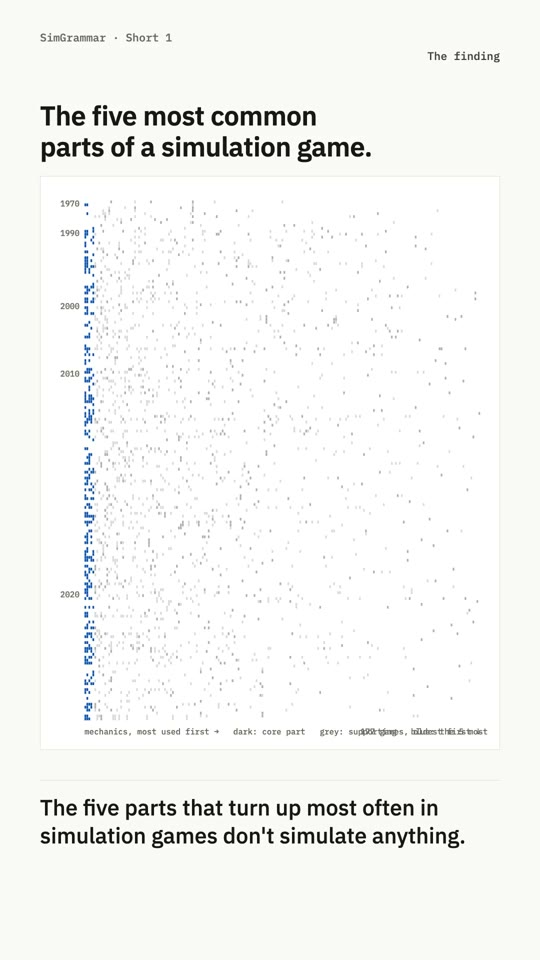
The five parts that turn up most often in simulation games don't simulate anything.
 Building placement
 Modding API
 play · 0:40
short 2 0:40
Every part of Stardew Valley is older than it
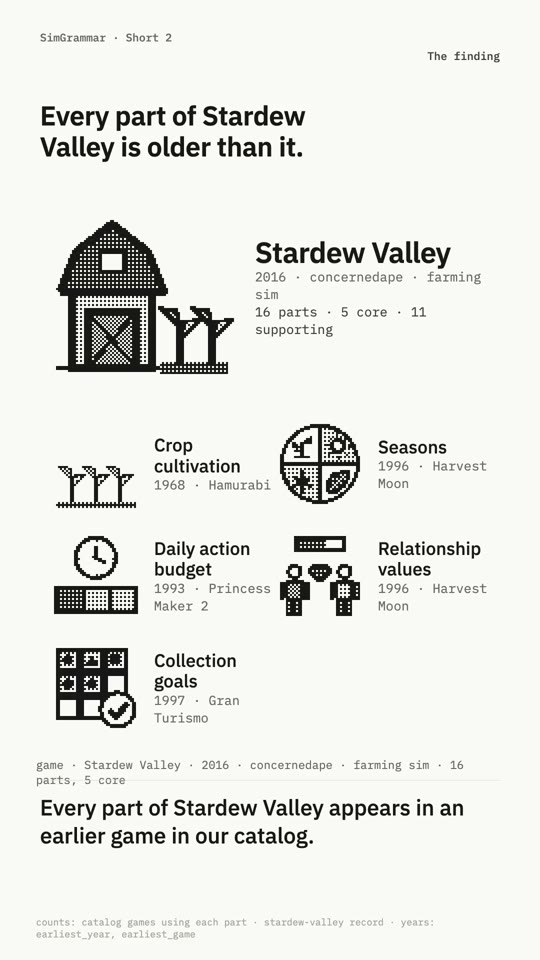
Every part of Stardew Valley appears in an earlier game in our catalog.
 Relationship values
 Crop cultivation
 play · 0:36
short 3 0:36
A border post and a daughter
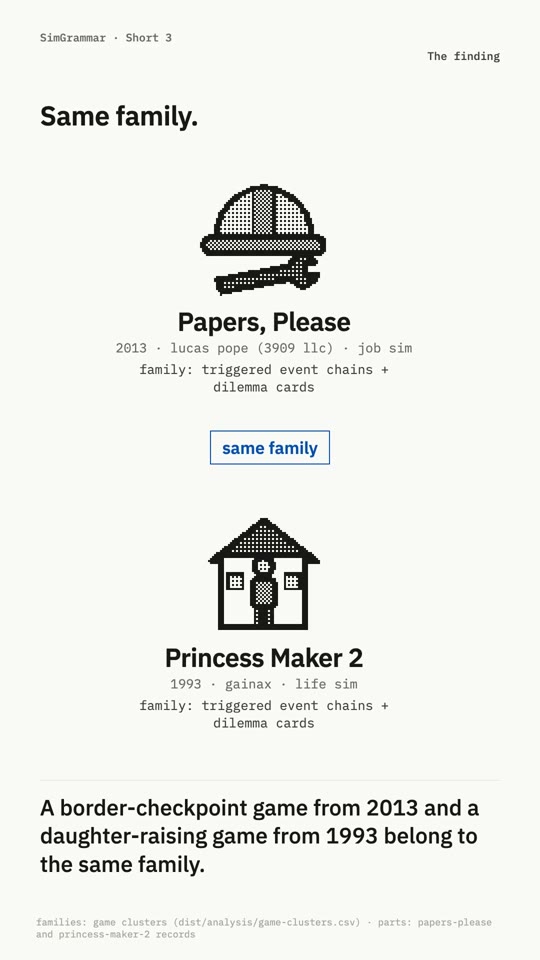
A border-checkpoint game from 2013 and a daughter-raising game from 1993 belong to the same family.
 Agent skills
 Treasury and budget
 play · 0:36
short 4 0:36
Decorating makes the raids bigger
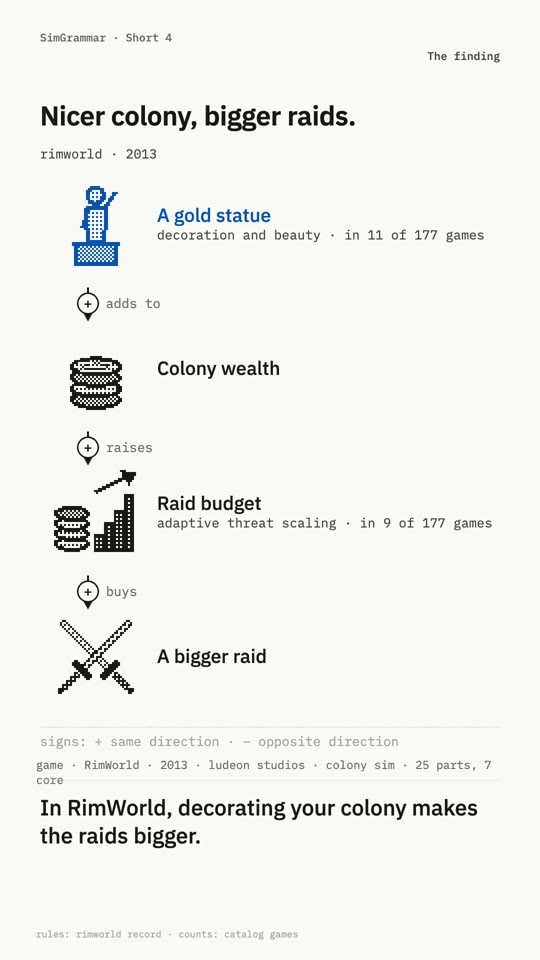
In RimWorld, decorating your colony makes the raids bigger.
 Adaptive threat scaling
 Decoration and beauty
 play · 0:36
short 5 0:36
The refrigerator knows
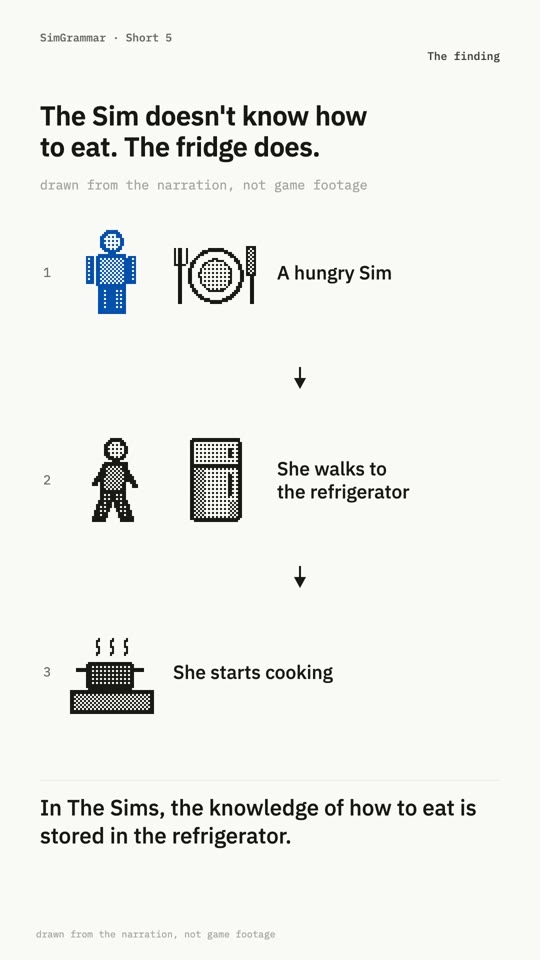
In The Sims, the knowledge of how to eat is stored in the refrigerator.
 Smart objects
 Needs decay
 play · 0:40
short 6 0:40
The one AI technique that's normal
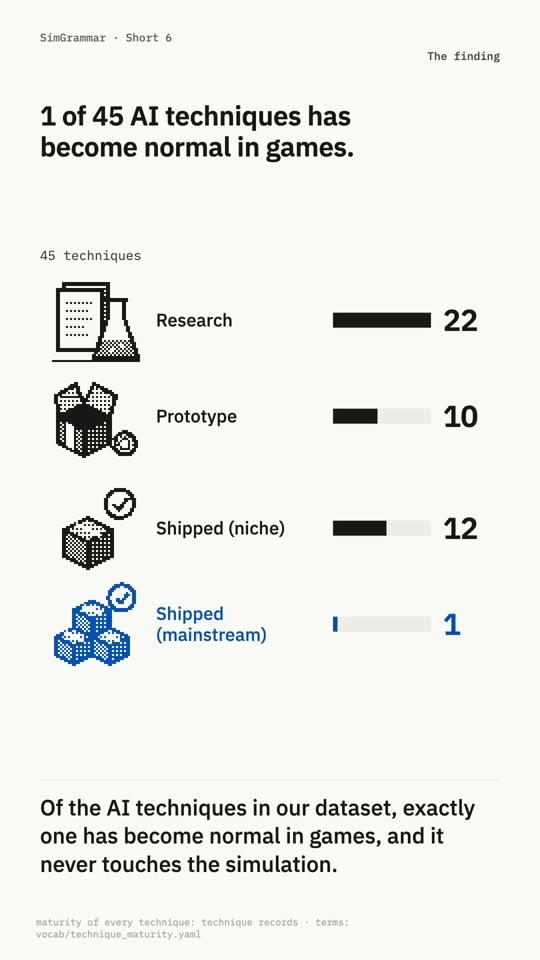
Of the AI techniques in our dataset, exactly one has become normal in games, and it never touches the simulation.
 Neural rendering in the graphics pipeline
 Genie foundation world models
 play · 0:36
short 7 0:36
Most used, barely touched
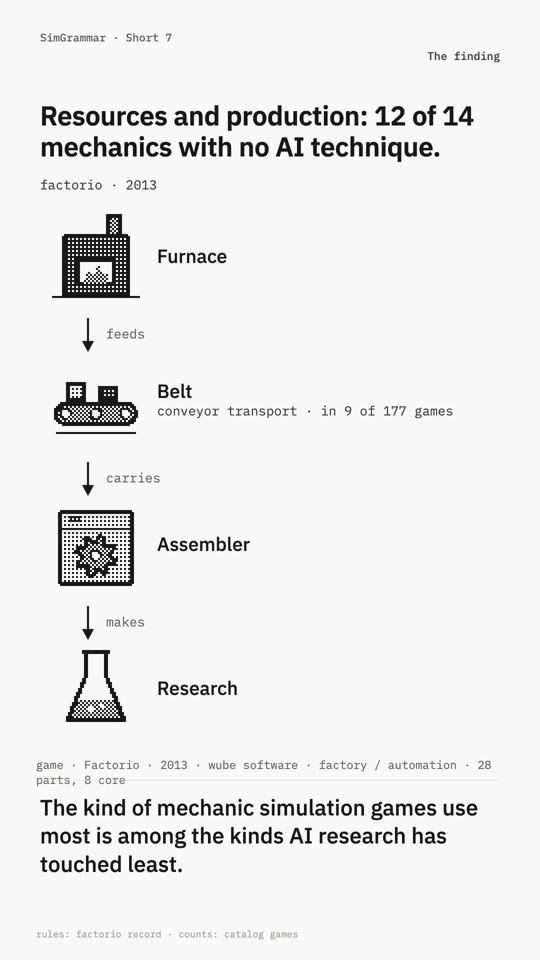
The kind of mechanic simulation games use most is among the kinds AI research has touched least.
 Production chains
 Conveyor transport
 play · 0:38
short 8 0:38
City builders don't tell stories
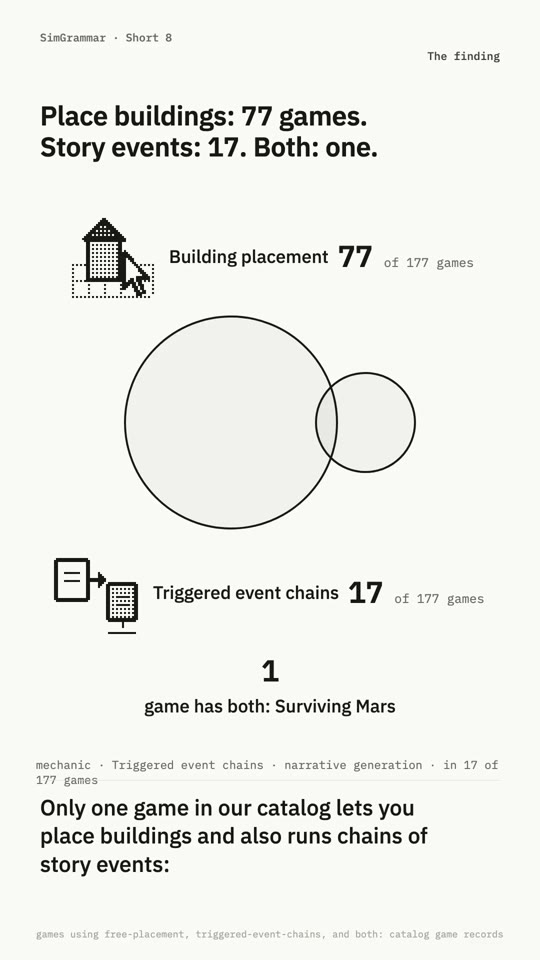
Only one game in our catalog lets you place buildings and also runs chains of story events: 77 games do the first, 17 the second.
 Triggered event chains
 play · 0:39
short 9 0:39
The why button
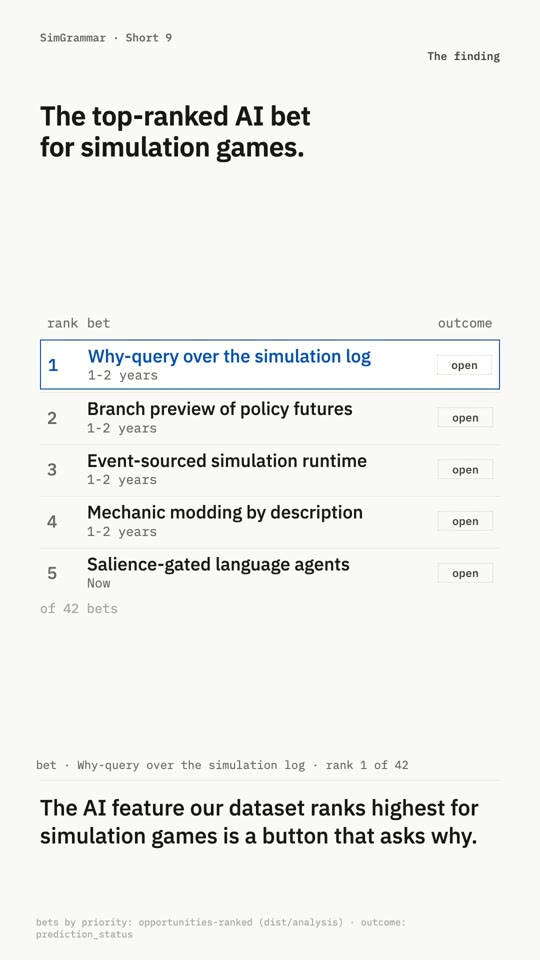
The AI feature our dataset ranks highest for simulation games is a button that asks why.
 play · 0:35
short 10 0:35
The faster computer
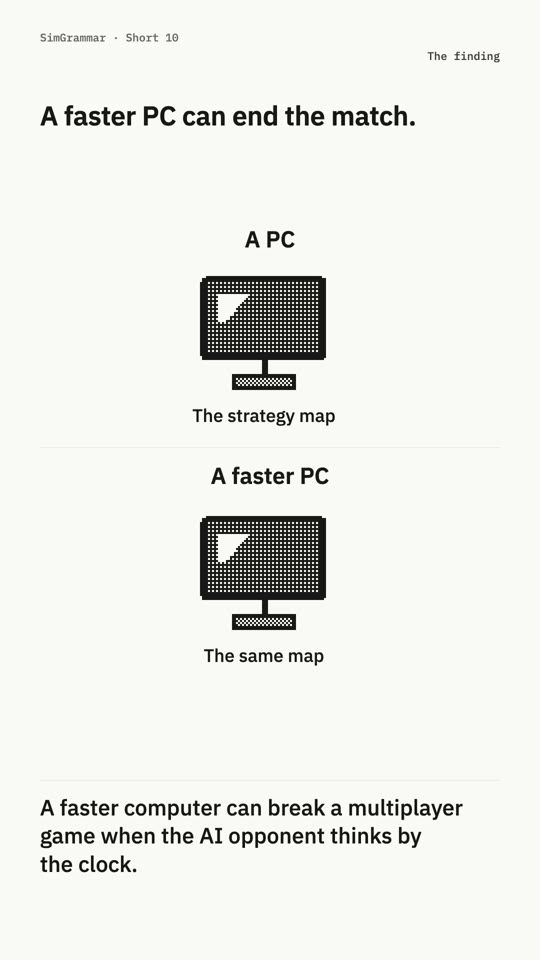
A faster computer can break a multiplayer game when the AI opponent thinks by the clock.
 Monte Carlo tree search for game AI
 LLM game master and narrative director
 play · 0:35
short 11 0:35
Due on the same day
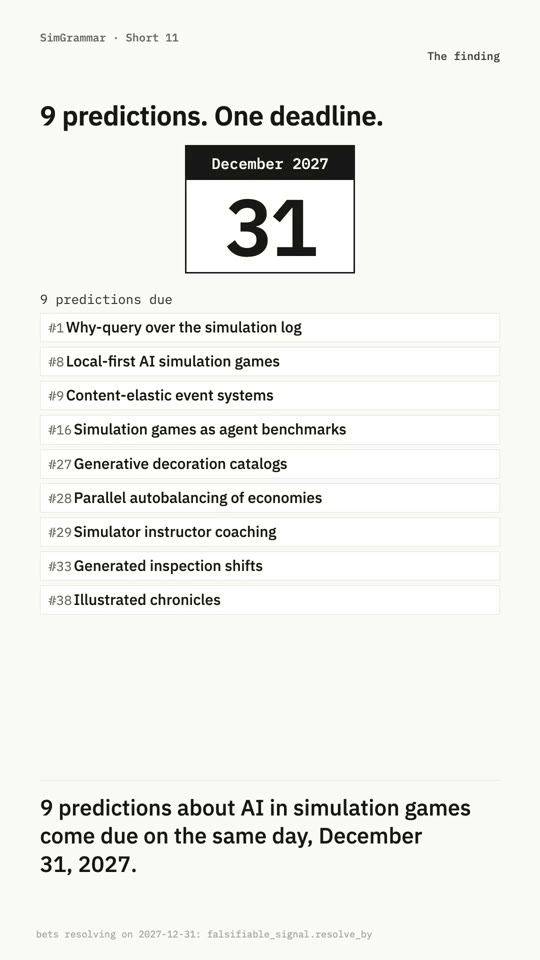
9 predictions about AI in simulation games come due on the same day, December 31, 2027.
 play · 0:33
short 12 0:33
The parts the agents skipped
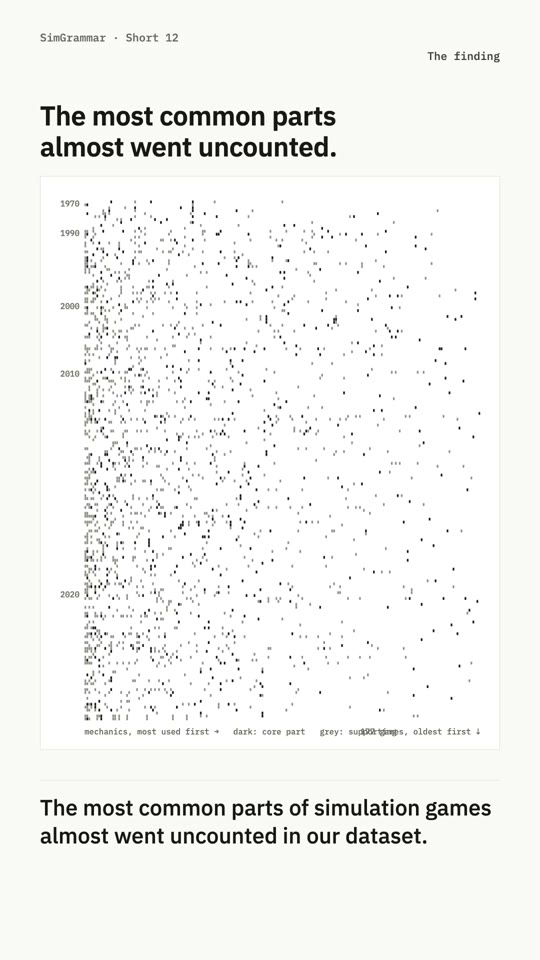
The most common parts of simulation games almost went uncounted in our dataset.
 Pause and speed control
plain-text twin · 12 transcripts
The five most common parts
The five parts that turn up most often in simulation games don't simulate anything.
We broke 177 of them into their parts. First is the pause button, in 47 percent of them. Then placing buildings where you like, support for mods, a tech tree, and scenario goals.
Production chains come sixth, and they're the first part on the list that models something in the world: ore into plates, plates into gears.
The parts a game is known for are rare. RimWorld's storyteller, its mood breaks and its body-part injuries each show up in fewer than ten catalog games.
Every part of Stardew Valley is older than it
Every part of Stardew Valley appears in an earlier game in our catalog.
Crops first appear in Hamurabi, a text game from 1968. A daily action budget first appears in Princess Maker 2, in 1993. Seasons and friendships with villagers first appear in Harvest Moon, in 1996, the game Stardew was built in response to.
That is the norm. Games released since 2010 draw 84 percent of their mechanics from parts that already existed by 2000.
Stardew sets its own numbers: 250 friendship points a heart, and two lost on each day you don't talk to someone.
A border post and a daughter
A border-checkpoint game from 2013 and a daughter-raising game from 1993 belong to the same family.
We grouped 177 simulation games by the parts they're built from, then redid the grouping on 1000 random subsets of the catalog. These two land together almost every time.
Both give you time in fixed slots: a shift at the border, three slots a month for your daughter. Both keep money tight. Both keep sending authored events at you.
Princess Maker 2 is filed as a life sim, and it lands far from The Sims.
Decorating makes the raids bigger
In RimWorld, decorating your colony makes the raids bigger.
Before every raid the game adds up your colony's wealth and your colonists and turns the total into a budget for the attackers. Wealth starts adding to that budget above 14,000 and keeps adding up to a million [1].
So experienced players keep their colonies plain. They skip the statues and the fine furniture so the raids stay small.
None of it is on screen. The formula lives on the community wiki, and the dataset scores the mechanic 2 out of 5 for legibility, the level where players understand it only through wikis.
The refrigerator knows
In The Sims, the knowledge of how to eat is stored in the refrigerator.
Every object advertises what it offers. The refrigerator advertises Hunger, the bed Energy. A Sim weighs the offers in reach against what it needs and picks one, and the object brings the script and the animation [1].
Expansions taught Sims new things largely by selling them new objects.
It also meant every behavior was made by hand. The base game shipped with more than 150 objects, and the dataset scores the method 4 out of 5 for authoring cost.
The one AI technique that's normal
Of the AI techniques in our dataset, exactly one has become normal in games, and it never touches the simulation.
It's neural rendering: upscaling, and frames predicted between the ones the game drew. More than 250 titles support multi-frame generation, and Flight Simulator has frame generation too [1] [2].
A generated frame sits between two real ones, and the simulation never knows. Saves, replays, and multiplayer stay exactly as they were.
The models that would replace the game world itself are still prototypes. Google's Project Genie, built on Genie 3, caps each world at sixty seconds to save compute [3].
Most used, barely touched
The kind of mechanic simulation games use most is among the kinds AI research has touched least.
Resources and production is the most used family in our catalog. Of its 14 mechanics, 12 have no AI technique pointed at them, production chains included.
A furnace starves far upstream, and the player blames the building in front of them. The record for production chains lists that as a known failure in games without flow statistics.
Instead the techniques pile up on stories and characters. Narrative and generation is the most exposed family in the set.
City builders don't tell stories
Only one game in our catalog lets you place buildings and also runs chains of story events: 77 games do the first, 17 the second.
In Cities: Skylines, a district built all at once grows old all at once. Decades later its residents die in a wave, and the hearses back up. The game treats it as a services problem. Nothing tells you a story about any of them.
The exception is Surviving Mars, which lays authored mysteries like plagues and AI revolts over a colony you lay out yourself. Even there, the mysteries are layered on top of the colony.
The why button
The AI feature our dataset ranks highest for simulation games is a button that asks why.
We scored 42 bets on impact, feasibility, and novelty, and this one came first. Right-click the hospital that closed three months ago, ask why, and get a few sentences, each linked to an event in the game's own log. The model can only say what it can point to. If it can't ground an answer, it says so.
The bet has a deadline. If no game with at least ten thousand Steam reviews ships it by December 31, 2027, answering free-text questions from the player's own save, it loses.
The faster computer
A faster computer can break a multiplayer game when the AI opponent thinks by the clock.
In lockstep multiplayer, both machines run the same world and send each other only orders. Give the opponent a fixed slice of time to think, and the faster machine thinks further and picks a different move. The two worlds split, and the match ends.
Of the AI techniques in our dataset that can run during play, 10 break reproducibility outright. For this opponent, the fix is one rule: count the playouts instead of the milliseconds, and seed the random numbers.
Due on the same day
9 predictions about AI in simulation games come due on the same day, December 31, 2027.
Every bet in our dataset carries one, written so a stranger could check it. Take the first: a widely played game lets you ask why something happened in your own save. It only counts if it shipped after October 24, 2026, in a game with ten thousand Steam reviews, answering from your save and not from a manual.
And the person who checks can't be the one who made the bet, or the same AI model that wrote it.
The parts the agents skipped
The most common parts of simulation games almost went uncounted in our dataset.
The first catalog was built by AI agents working in parallel. Each one recorded the parts that made a game distinctive and skipped the obvious ones: the pause button, placing buildings, tech trees. An outside review caught it.
Once the gaps were filled, the pause button turned out to be the most common part of all, in 47 percent of the catalog. Now every number in this series is checked against the data each time it's built.