episode 2 of 12 8:04 10 scenes book chapter 3
Where the parts came from
Hamurabi, from 1968, already used parts that games still use. Most of the vocabulary was in a catalog game by 2000, a test against chance shows how much of that comes from parts being widely shared, and recent games are built mostly from old parts.
 play · 8:04
in the book
the chapter this episode followschapter 3 3,461 words about 15 min 119 records
Old parts
In this chapter: Dating a mechanic · Most of it by 2000 · A test of the claim · The founding games · What came after · Careers · Built from older parts · Named influences · Exercise: date a game.
games in this episode
24 named in the narration, 3 more on screen

Stardew Valley
A farming and life sim in which the player restores an inherited farm over four 28-day seasons, splitting a daily energy budget among crops, animals, mining, fishing, and friendships with Pelican Town's residents.


Sid Meier's Civilization
A turn-based 4X game in which the player guides a civilization from 4000 BC toward the space age by founding cities, researching a technology tree, building one-per-world wonders, and competing with rival civilizations by diplomacy or war.
on screen 1:01
Railroad Tycoon
A railroad business sim in which the player lays track, builds stations, schedules trains to meet regional supply and demand, and battles rival barons through the stock market.
on screen 1:05



Conway's Game of Life
A zero-player cellular automaton on an infinite square grid in which each cell lives or dies by the B3/S23 neighbor-count rule, producing gliders, oscillators, and universal computation from a seeded pattern.
on screen 1:24

Europa Universalis IV
A real-time-with-pause grand strategy game in which the player directs one of over 500 nations from 1444 to 1821 through monarch-point spending, trade-node competition, colonization, diplomacy, and war on a province map.
on screen 1:32

Little Computer People
A 1985 home-computer life sim in which one procedurally seeded little person lives in a cross-section of a three-story house, follows a daily routine, and depends on the player for food, water, and attention.
on screen 3:30
The Incredible Machine
A Rube Goldberg puzzle game in which the player places supplied parts such as balls, ropes, pulleys, belts, and animals into a level so that a deterministic physics run completes a simple goal.
on screen 3:44

Theme Park
A theme park management game in which the player builds rides and shops, tunes prices and recipes for individually simulated visitors, and sells parks to expand worldwide.
on screen 4:12

A Tale in the Desert
A combat-free MMO set in ancient Egypt in which players gather, craft, and build, pass tests in several disciplines, and govern the world through player-written petitions and votes, with the world wiped and restarted at the end of each Telling.
on screen 4:38
EVE Online
A single-universe space MMO in which players mine, manufacture, trade, and fight in ships that are destroyed for good, inside a player-made economy and a galaxy of high-, low-, and null-security space where player alliances claim sovereignty.
on screen 4:38

Dwarf Fortress
A colony sim in which the player directs a fortress of autonomous dwarves inside a procedurally generated world whose history, geology, fluids, bodies, and minds are all simulated.
on screen 4:55

Papers, Please
A border inspection game in which the player checks entrants' documents against daily-changing rules on a timed shift and spends the wages on a family's rent, food, and heat.
on screen 5:18

AI Dungeon
A text adventure in which a large language model continues the story after each player input, so actions, dialogue, and world facts the player types are improvised into narration rather than resolved by authored rules.
on screen 5:43
The Oregon Trail
An educational turn-based travel sim in which the player buys supplies and sets rations for a wagon journey to Oregon while random events, weather, and illness threaten the party.
on screen 6:09
Harvest Moon
An early farming sim for the Super Famicom in which the player has two and a half years to restore an inherited farm through daily crop watering, livestock care, and courting one of five eligible women.

also on screen · 3 games
mechanics in this episode
19 named in the narration, 64 more on screen
Crop cultivation
Planted crops progress through growth stages over days or seasons depending on water, soil, and season, then are harvested.

Culture and religion conversion
Provinces or population groups carry culture and faith identities that drift or are converted by missionaries, policies, and rulers, changing unrest, opinion, and bonuses.
on screen 0:39


Loans and debt
Capital can be borrowed at interest with repayment schedules, so leverage accelerates both growth and failure.
on screen 1:34

Land value
Each location's value is computed from nearby amenities, nuisances, and access, and it drives density and building upgrades.
on screen 2:53

Power grid
Generators produce energy that is distributed over a connected network to consumers; shortfalls cause brownouts or shutdowns.

Traffic congestion
Trips route over a capacitated network; volume beyond capacity raises travel time and delays services and deliveries.
on screen 2:53

Production chains
Buildings or machines convert input goods into output goods via fixed recipes and cycle times, forming multi-step dependency trees.

Trade routes
Goods are exchanged between settlements, regions, or foreign markets along routes with price differences, tariffs, and transit time.
on screen 3:30

Rigid-body physics
Objects with mass and inertia move under forces and collide, constrained by contacts and joints solved each step.
on screen 3:44

Personality traits
Fixed or slow-changing traits change each agent's needs, preferences, and available actions.
on screen 3:56

Utility action selection
Agents choose actions by scoring options against needs and context, then picking the highest or sampling among high scores.
on screen 4:12

Seasonal world reset
A shared world runs for a bounded season and is then wiped and restarted, often with rule changes carried into the next season.
Conveyor transport
Items move continuously on belts or lanes with throughput limits, splitters, merges, and priorities.

Interest groups
Factions within a polity have clout and preferences over policies, and their approval gates what the player can do.
on screen 5:18

War score and peace terms
Each war tracks a score or exhaustion level from battles, occupation, and war goals, and that value caps what a peace settlement can demand or forces capitulation.
on screen 5:18

Survival meters
The avatar's bodily stocks such as hunger, thirst, warmth, and fatigue deplete over time and, if unmanaged, drain health and kill.
on screen 6:09

also on screen · 64 mechanics



















































techniques in this episode
1 on screen, in order of appearance
LLM game master and narrative director
A language model that adjudicates player and NPC intentions, decides outcomes, generates events and quests, and narrates them, either free-form or checked against a typed world state and canon.
on screen 5:42
shorts from this episode
1 · under a minute each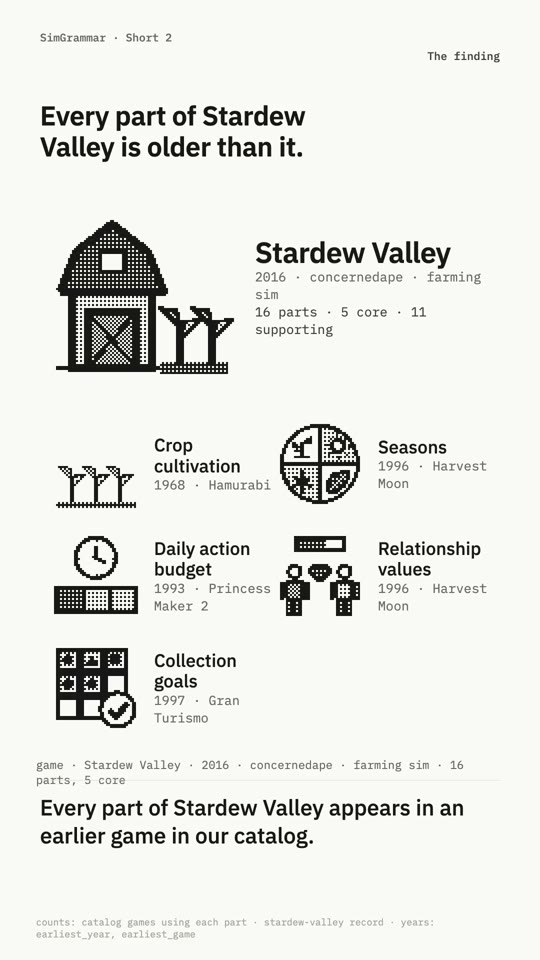 play · 0:40
short 2 0:40 from chapter 3 · episode 2
Every part of Stardew Valley is older than it
Every part of Stardew Valley appears in an earlier game in our catalog.
transcript
every number checked against the dataset when the episode was renderedread the transcript, scene by scene · 10 scenes
Cold open
In 1968 a city game ran on a minicomputer. Once a year your steward reports, and you answer with three numbers: land to buy, grain to feed people, acres to plant. Grain is food, seed, and money at once. Feed too little and people starve. Starve too many in one year and you lose the throne.
Hamurabi in parts
That game is Hamurabi. The dataset behind this series lists 6 mechanics in it, and all of them are still in use. Crop growing turns up in 25 games in the catalog, including Stardew Valley.
A date is a lower bound
The dataset dates a mechanic by the first game in the catalog that uses it. That is a floor. Hamurabi itself was written from a description of an older program, The Sumerian Game, from 1964, which the catalog does not hold.
Plenty of the rest came from outside games altogether. SimCity took its model of urban growth from Jay Forrester's book Urban Dynamics. Civilization took its technology tree from a board game, and Railroad Tycoon started from another board game, 1830. The Sims borrowed its idea of a house from an architecture book, A Pattern Language. Factorio grew out of two Minecraft mods that added pipes and machines.
The edges of the catalog produce odd firsts. The earliest catalog game with a pause button, and with free placement, is Conway's Game of Life, from 1970, because seeding cells and choosing how fast generations run are those two mechanics at their barest. Europa Universalis IV gets the credit for dynasties and religious conversion, and the catalog holds no earlier Europa Universalis game.
Most of it by 2000
With that caveat, the count is lopsided. Of 199 mechanics, 69 percent appear in a catalog game from 2000 or earlier. Those early games are only 21 percent of the catalog. The 1990s alone added 80 mechanics, the most of any decade.
The two steepest years are 1989, when SimCity and Populous came out, and 2013, the year of Europa Universalis IV, Factorio, and Papers, Please.
Testing the story
It looks like a golden age. Chance can produce something similar. Draw 37 games at random from every era, trim each one to the size of an early game, and count the mechanics they cover. Do it two thousand times.
A random set covers 129 mechanics on average. The real early games cover 137. Random sets match or beat them in about one draw in nine.
So most of that headline number comes from how widely the parts are shared. A few dozen games from any period show most of the vocabulary. What survives the test is narrower: new parts come from a handful of games in every decade, and later games are built mostly from parts that already existed.
The founding games
SimCity is credited with 10 mechanics, among them zoning, land value, demand for homes, shops, and industry, the power grid, crime, pollution, and traffic. The city is a stack of coarse maps recomputed in passes. When the code was released in 2008 the rules became readable: crime in a block is 128, minus land value, plus density, minus police.
M.U.L.E., from 1983, introduced production chains and prices set by supply and demand. Food sets how long your turn lasts, energy shortages stop your plots, and players walk toward a price to make a trade. Ties go to whoever is behind.
Elite, from 1984, regenerated eight galaxies of 256 systems from a seed instead of storing them, which let a universe fit on an eight-bit machine. It is the catalog's first game with generated terrain and with trade routes. The Incredible Machine, from 1993, brought rigid-body physics and sharing your designs with other players, and its physics has no random numbers, so a machine that works once works every time.
Little Computer People, from 1985, introduced needs that decay, personality traits, and typing requests in plain English to a character who decides, depending on his mood, whether to do what you ask. Each disk's serial number seeded a different resident.
Theme Park, from 1994, gave every visitor a record of about 200 bytes and let each one choose what to do next by scoring the options against its needs. The catalog dates that architecture, utility action selection, to Theme Park, six years before The Sims made it famous. You could also change the recipe as well as the price: more sugar in the ice cream cost more, and brought customers back.
After 2000
The 2000s added 32 mechanics, several from online worlds where the other players are part of the simulation. In A Tale in the Desert, from 2003, players write laws and vote on them. EVE Online's market, from the same year, is almost entirely player-made.
The single largest source of new parts in the catalog came after the 2000 line. Dwarf Fortress, from 2006, is credited with 11, more than any other game: water and magma that flow tile by tile, heat, mood breaks, bodies made of layered tissue, migrants drawn by success, and a simulated history that runs for centuries before you arrive.
Since 2010 the catalog adds 33 mechanics, mostly from four lineages. Factory games brought conveyor belts and logistics robots. Grand strategy brought interest groups, war score, and dynasties. Job simulators brought document checks and repair. And physics sandboxes brought vehicles that bend and terrain that deforms.
The newest arrivals come from language models. AI Dungeon, from 2019, continues the story after every line you type, with no world state outside the text. The research town of Generative Agents, from 2023, added gossip: seed one character with a plan for a party, and over two game days the news reaches about half the town.
Belts spread fast for a recent part. They reached a fifth catalog game in 2019, and 9 games use them today.
Parts that waited
Other parts sat still for decades. Survival meters, stocks of food and medicine that run down, are core in The Oregon Trail, from 1971. The next catalog game with them is Minecraft, in 2009.
Crops waited from Hamurabi to Harvest Moon, in 1996. RimWorld's work grid, colonists down one side and jobs across the top, first shows up as a minor part of SimAnt in 1991, where you balance an ant colony's workers, soldiers, and breeders. The next catalog game with it is Kenshi, in 2013. Some of those gaps come from the catalog being thin before 1990. Some are real: a part sat in a few games until a later design gave it a central job.
Built from older parts
Games released since 2010 draw 84 percent of their mechanics from parts that existed in the catalog by 2000. Stardew Valley introduced none. Its designer built it in response to Harvest Moon, the catalog's first game with seasons and with relationships to villagers.
Stardew sets its own numbers. Friendship is 250 points a heart, and you lose two points on each day you don't talk to a villager. A day ends when your energy or the clock runs out.
Factorio's core has the same history, plus one new part. Its extraction, production chains, power grid, pollution, tech tree, raids, and escalating enemies all predate it in the catalog. The conveyor belt is the exception, and the game is built around it.
Close
Try it with a game from this year. List its parts, look up the first catalog game for each, and count the new ones. Most of the time you will find a few, and they are usually the parts the game is known for.
Factorio and Anno 1800 are both built on production chains, and the dataset puts them in different families. Next episode: how those families are drawn, and the games they put side by side.