episode 8 of 12 7:33 11 scenes book chapter 9
Vacant lots
Pairs of common mechanics that almost never share a game, like a city builder that tells stories or a production game whose workers grow old. A few lots are already built by a single game, and some may stay empty for good reason.
 play · 7:33
in the book
the chapter this episode followschapter 9 4,281 words about 19 min 117 records
Vacant lots
In this chapter: Packages · Lots no one has built · Five lots · Goals and open runs · Two kinds of city builder · Two more lineages · Lots already built · What makes a lot worth building · Exercise: survey a lot.
games in this episode
20 named in the narration, 1 more on screen
Cities: Skylines
A city builder in which road-following zones, agent citizens who route to work along computed paths, district policies, and player-drawn transit lines make traffic flow the central design problem.
Surviving Mars
A Mars colony city builder in which drones build power, water, and oxygen networks before colonists with traits arrive in domes, while research, Earth sponsors, and dust storms, meteors, and cold waves shape survival.
on screen 0:21

Crusader Kings III
A character-driven grand strategy game in which the player rules as successive heads of a medieval dynasty from 867 or later to 1453, managing traits, stress, vassal opinion, marriages, and succession across a map of feudal titles.
Manor Lords
An early-access medieval city builder in which families settle gridless burgage plots along curved roads, fields depend on soil fertility and crop rotation, and the lord fields retinue and militia in real-time battles.
on screen 1:01


Captain of Industry
An industrial colony builder in which the player reshapes island terrain with excavators and trucks, runs production chains to feed, house, and power a settlement, and spends the Unity its satisfied population generates on edicts, quick builds, and world-map expansion.
on screen 3:19

SpaceChem
A programming puzzle game in which the player lays out instruction paths for two waldos in grid reactors that grab, bond, rotate, and split atoms into target molecules, with each solution scored on cycles, reactors, and instructions against global histograms.
on screen 4:03


Stellaris
A real-time-with-pause space 4X and grand strategy game in which the player designs a species and empire, expands across a procedurally generated hyperlane galaxy from 2200, manages pops, jobs, ethics-based factions, and research card draws, and faces late-game crises.
on screen 4:44

Game Dev Tycoon
A game-studio business sim where the player picks topic, genre, and platform for each game, splits development effort across design and technology focus areas, and lives or dies by review scores across the history of the industry.
on screen 4:58
Against the Storm
A roguelite city builder in which each settlement must fill a reputation gauge before the Queen's impatience runs out, balancing three villager species' needs while opening dangerous forest glades under a recurring blightstorm.
on screen 5:20


Prison Architect
A prison management sim in which the player builds a facility, sets an hourly regime, and staffs it while hundreds of prisoners pursue needs whose neglect leads to fights, escapes, and riots.
on screen 5:20

Kerbal Space Program
A space flight sim where the player assembles rockets from parts and flies them under patched-conic orbital physics and atmospheric aerodynamics through a scaled-down planetary system.
on screen 6:01

also on screen · 1 game
mechanics in this episode
20 named in the narration, 11 more on screen
Triggered event chains
Authored event templates fire when state conditions hold, and their outcomes schedule follow-up events that chain into multi-step stories.
on screen 0:21

Attribute-driven match engine
Contest outcomes are simulated play by play from participant attributes, tactics, and randomness instead of being played directly.
on screen 1:12

Culture and religion conversion
Provinces or population groups carry culture and faith identities that drift or are converted by missionaries, policies, and rulers, changing unrest, opinion, and bonuses.
on screen 1:12

Land value
Each location's value is computed from nearby amenities, nuisances, and access, and it drives density and building upgrades.

Negotiation
The player and an AI party exchange offers and counteroffers over wages, prices, or contract terms against the AI's hidden reservation value until a deal is struck or talks fail.
on screen 1:12

Traffic congestion
Trips route over a capacitated network; volume beyond capacity raises travel time and delays services and deliveries.

War score and peace terms
Each war tracks a score or exhaustion level from battles, occupation, and war goals, and that value caps what a peace settlement can demand or forces capitulation.
on screen 1:12

Player organizations
Players form corporations, guilds, or governments with membership, roles, permissions, and shared assets.
on screen 1:39

Lifecycle and aging
Agents are born, age through life stages with different capabilities, and die.
on screen 3:19

Production chains
Buildings or machines convert input goods into output goods via fixed recipes and cycle times, forming multi-step dependency trees.

Content sharing
Player creations such as buildings, creatures, or blueprints are uploaded, browsed, rated, and imported into other players' games.
on screen 4:03

Blueprints
Player-made layouts can be saved, stamped as build orders, copied, and shared as text or files.
on screen 4:27


Personality traits
Fixed or slow-changing traits change each agent's needs, preferences, and available actions.
on screen 4:55

Power grid
Generators produce energy that is distributed over a connected network to consumers; shortfalls cause brownouts or shutdowns.
on screen 5:20

Permadeath
Death of agents or the avatar is permanent, and the save system prevents undoing it.

Reputation
A standing value with a faction or the public changes access, prices, and how others respond.
on screen 5:48

Treasury and budget
A money stock with income and expense flows such as taxes, upkeep, wages, and service funding; a negative balance leads to debt or failure.
on screen 6:39

Crop cultivation
Planted crops progress through growth stages over days or seasons depending on water, soil, and season, then are harvested.
on screen 6:39
Labor market
Workers fill jobs by type and education; mismatches create unemployment or labor shortages that throttle production.
on screen 7:14
also on screen · 11 mechanics











shorts from this episode
1 · under a minute each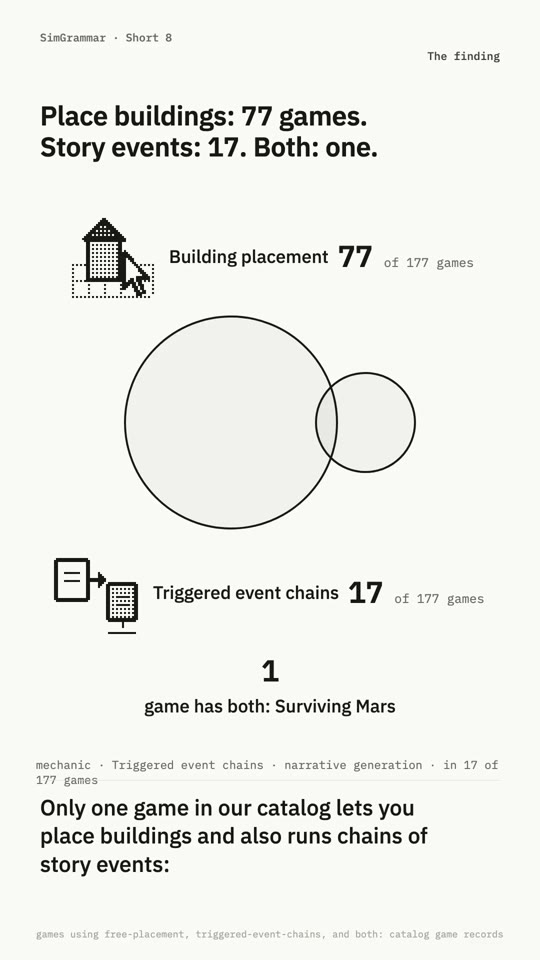 play · 0:38
short 8 0:38 from chapter 9 · episode 8
City builders don't tell stories
Only one game in our catalog lets you place buildings and also runs chains of story events: 77 games do the first, 17 the second.
transcript
every number checked against the dataset when the episode was renderedread the transcript, scene by scene · 11 scenes
Cold open
Everyone in this district moved in the same year. So they grew old together, and now a wave of deaths is coming faster than the hearses can collect them. Cities: Skylines shows you a deathcare problem. It has no way to show you a story about any of them.
The missing story
Placing buildings is in 77 catalog games. Event chains, the machinery that lets Crusader Kings III follow a rival's illness with a succession crisis and then a war, are in 17. If the two were spread across games at random, several games would have both. One does: Surviving Mars, whose Mysteries lay authored storylines like plagues and AI revolts over a colony you lay out yourself. Even there, the Mysteries are layered on top of the colony. Picture the other version: a tavern built next to the temple, or a mill whose pond floods a farmer's field, firing a short event about the people it affects, with a choice and a consequence the game keeps track of. Frostpunk, Manor Lords, and Islanders each do a piece of it.
Call those vacant lots: two mechanics, each common, from different corners of the design, that almost never share a game.
Packages
Some pairs turn up together far more often than chance. The strongest come in packages, inherited down a lineage. Sports management carries a match engine, a board that rates the manager, and contract talks. Grand strategy carries war score and religious conversion. City builders carry SimCity's land value and traffic. Flight sims pair aerodynamics with cockpit checklists. Online worlds pair a shared, persistent world with player-run corporations and guilds. The Sims pairs what a Sim wants with objects that advertise what they offer.
In a package, each part changes the other's state. In SimCity, a block's value falls with pollution and crime and distance from the centre, and traffic writes pollution into the same map. So your road plan changes what the land is worth, and the land decides where the city grows next. Take either one away and the other loses its point.
The lots
The dataset looks for the opposite on purpose. It takes mechanics that each appear in at least 14 games, pairs them across different families, leaves out time controls, and leaves out pairs already recorded as being in tension. Then it keeps the pairs that share one game or none. 269 pairs pass. The bar of 14 games was 8 percent of the catalog when it was set, and it's written down to be revisited as the catalog grows.
The tension list is what designers already know about pairs that fight. Threat that grows with your wealth pulls against unlocks that reward growth. Characters with strong free will resist direct orders. Full-information overlays undercut fog of war. A shared online world can't be paused by one player. Generated content resists the authored conditions that event chains depend on. Those pairs are left out on purpose. What's left is emptiness without an explanation on record.
The chance baseline has a known weakness. It treats each mechanic as spread across games regardless of how many mechanics a game has, so pairs whose mechanics live in small games can look emptier than they are. A stricter baseline would shorten the list. Treat it as a list of candidates.
Workers who grow old
Aging lives in 23 games. Production chains live in 38. No catalog game has both. Banished comes closest from one side: every worker is born, ages, and dies, so a decision you made years ago shows up as a labour shortage today. But its families gather, farm, and stockpile without anything the dataset records as a production chain. From the other side, Captain of Industry and Workers & Resources run deep industrial economies, and neither record lists workers who age or retire.
Put them together and a factory's bottleneck could be a missing mentor as easily as a missing machine. The demographic wave that fills Cities: Skylines with hearses would show up, years later, as a production line running short-handed.
Shared designs
Content sharing, where players upload what they build and others browse, rate, and import it, is in 24 games, mostly sandboxes, life sims, contraption builders, and management games. The one production game with it is SpaceChem, whose ResearchNet distributed puzzles that players made. Factorio players do trade layouts, as blueprint strings pasted between games, and the dataset files that under blueprints. What no production game has built is the shared catalog that Spore made for creatures: a place where a factory layout is published, remixed, and ranked. Part of a lot's emptiness can come from where the vocabulary draws its lines, and this is one of those cases.
Research by people
Tech trees are in 43 games. Relationships between named characters are in 21. They share exactly one, Crusader Kings III. Stellaris gets partway: its research cards are weighted by the traits of the scientist leading each field. Game Dev Tycoon hires designers and programmers with their own stats, but its research points come from a separate pool. Everywhere else, research is a currency you spend on a graph. Run it through a few named scientists who collaborate, compete, and hold grudges, who publish, poach each other, and defect to rivals, and breakthroughs become events with names attached.
Lots already built
Some games already stand on lots nobody else has built. Prison Architect is the only catalog game that hires staff one by one and also wires a power grid, and the only one that pairs a budget with shared player creations: you can download someone's prison and try to break out of it. Kenshi is the only one where production chains meet permanent death. Against the Storm is the only one that sets scenario goals on generated maps: each settlement is a new map, won by filling a reputation gauge before the Queen's patience runs out. A lot with one building on it still counts as vacant here, and it might be the more useful kind, because somebody has already shown it can stand.
Lots that might stay empty
Hands-on skill, like flying and driving, and placing buildings share no game at all. Most flight and racing sims have no use for a town. The lot next door is built: Kerbal Space Program and Besiege have you assemble a machine from parts and then fly or drive it yourself. What no catalog game does is the version where you build the place, the track or the airfield, and then drive it.
Other empty pairs are two lineages that haven't met. Permanent death lives mostly in colony sims, survival games, and virtual pets; scenario goals live mostly in city builders, tycoons, and vehicle sims; the two never share a game. A city treasury and growing crops never share one either.
How a lot closes
The catalog is a sample. It leans toward games well documented in English, and a game outside it may already combine any of these pairs. That's the cheapest way to close a lot: add the game, with its sources. The table recomputes, and any sentence in this series that depended on the gap fails its check until someone rewrites it.
And a lot is worth building when the two mechanics change each other. Traffic and land value do, in SimCity. Placement and events would, if the events changed what you build next. Aging and production would, if the age of the workforce set the factory's output years later.
Close
Next episode turns the largest gaps, the missing techniques, and the five ceilings into 42 bets, each with an experiment and a prediction with a date on it.