episode 7 of 12 7:31 11 scenes book chapter 8
Where AI lands
Infinite Craft stores a language model's answer and treats it as a rule. Counting every technique against every mechanic shows research aimed at generative content, while the economic core most games are built from has almost nothing aimed at it.
 play · 7:31
in the book
the chapter this episode followschapter 8 4,707 words about 20 min 96 records
Where AI lands
In this chapter: Seven ways to change a mechanic · Where the set comes from · Counting exposure · What the techniques would change · The economic core · Research that would tune the economy · The most exposed mechanics · Judgment against evidence · Exercise: aim a technique.
games in this episode
10 on screen, in order of appearance
Infinite Craft
A browser crafting game in which combining any two elements yields a new element whose name and emoji a language model generates on first request and a shared database then fixes for all players.


Dwarf Fortress
A colony sim in which the player directs a fortress of autonomous dwarves inside a procedurally generated world whose history, geology, fluids, bodies, and minds are all simulated.
on screen 2:20

Victoria 3
An economic grand strategy game set from 1836 to 1936 in which the player industrializes a nation by building production chains, passing laws through interest-group politics, and pursuing diplomatic plays while population strata respond through wages, needs, and radicalism.
Crusader Kings III
A character-driven grand strategy game in which the player rules as successive heads of a medieval dynasty from 867 or later to 1453, managing traits, stress, vassal opinion, marriages, and succession across a map of feudal titles.

Microsoft Flight Simulator (2020)
A flight sim that streams a photorealistic model of the whole Earth built from map and photogrammetry data and flies aircraft through live weather with a surface-level aerodynamic model.
on screen 3:51

Theme Park
A theme park management game in which the player builds rides and shops, tunes prices and recipes for individually simulated visitors, and sells parks to expand worldwide.
on screen 4:12

mechanics in this episode
11 on screen, in order of appearance
Causal breakdown tooltips
Hovering a derived value shows the named modifiers that produce it, and terms inside the tooltip can be hovered in turn.
on screen 2:20

Memories and thoughts
Events create itemized, time-limited mood modifiers or lasting memories that shape later behavior.
on screen 2:20

Stress accumulation
A slow per-agent stress stock integrates negative experiences scaled by personality and, as it crosses levels, triggers breaks or lasting changes.
on screen 2:20

Generative content on demand
A generative model creates new content such as text, items, recipes, or rules at runtime in response to player input.
on screen 3:33

Procedural terrain
Maps are generated from a seed through noise, erosion, climate, and placement rules.
on screen 3:33

Utility action selection
Agents choose actions by scoring options against needs and context, then picking the highest or sampling among high scores.

Triggered event chains
Authored event templates fire when state conditions hold, and their outcomes schedule follow-up events that chain into multi-step stories.
on screen 4:15

Blueprints
Player-made layouts can be saved, stamped as build orders, copied, and shared as text or files.
on screen 4:18

Production chains
Buildings or machines convert input goods into output goods via fixed recipes and cycle times, forming multi-step dependency trees.
on screen 5:22

Crop cultivation
Planted crops progress through growth stages over days or seasons depending on water, soil, and season, then are harvested.
on screen 5:25

Rival firms
AI or player competitors contest markets, prices, and assets; market share decides who wins.
on screen 5:33
techniques in this episode
1 named in the narration, 44 more on screen
Deep reinforcement learning policies for NPC opponents and navigation
Neural control policies trained with deep reinforcement learning inside the game's own simulation drive opponents and NPCs, as with Sony AI's Gran Turismo Sophy, a selectable rival in Gran Turismo 7 since 2023.
also on screen · 44 techniques

























shorts from this episode
1 · under a minute each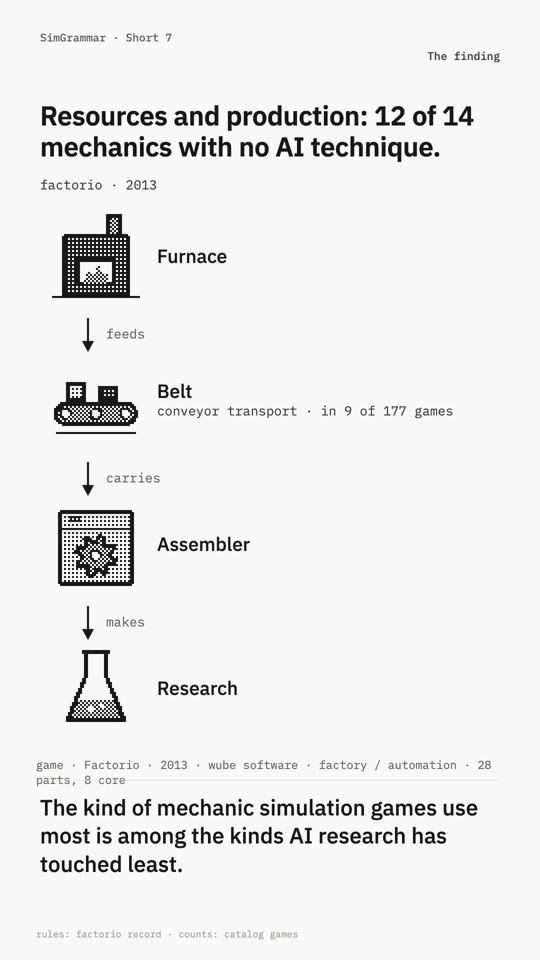 play · 0:36
short 7 0:36 from chapter 8 · episode 7
Most used, barely touched
The kind of mechanic simulation games use most is among the kinds AI research has touched least.
 Conveyor transport
transcript
every number checked against the dataset when the episode was renderedread the transcript, scene by scene · 11 scenes
Cold open
Every pair you try in Infinite Craft has an answer stored in a database every player shares. Until you try a pair nobody's tried. Then a language model names the result, the game saves it, and from that moment everyone who makes that pair gets your answer [1].
A rule decided once
That's the clearest case in the dataset of a language model deciding a rule in a shipped game, and it works because the decision only happens once. The cache turns an unpredictable model into a rule table that grows with play and gives everyone the same result. It bounds the bill too: the model only runs for pairs nobody has tried, so the cost grows with the number of new combinations and stays flat as players join.
It also helps that a combination has no right answer. When researchers asked GPT-4 to predict the next state of text games, across 76,369 transitions, it got the whole state right at most 59.9 percent of the time [2]. An Infinite Craft tile only has to be plausible once. A model asked to run a city's water table would have to be right every tick.
Where the techniques come from
The techniques in the dataset are recent. 27 of the 45 are dated 2023 or later, and the biggest single group is world models, the systems that generate a playable scene frame by frame. The set was built by looking for dated results that change a named game mechanic, so it probably leans toward fields that publish constantly and say so when they apply to games. A scheduling method from operations research that could balance a game's economy only gets in once someone applies it to a game and writes it down.
Seven kinds of change
Every technique in the dataset is linked to each mechanic it changes, and every link says how. It can replace how a mechanic works, the way inZOI's small model reads a Zoi's needs and surroundings to help pick its next action. It can deepen a mechanic, the way GT Sophy drives the same physics you do at a champion's level. It can enable a new version, like a teammate who takes spoken orders. It can cut the cost of making content, explain a mechanic to the player, tune it, or run it faster. Across 218 links, the most common is deepening. The rarest is explaining: 5 links, from 3 techniques, and only 1 of those links comes from something that has shipped.
Explanation by hand
Today, games that explain themselves do it by hand. RimWorld lists every thought behind a colonist's mood, with its value and when it expires; its systems were chosen partly for how readable their results are. In Crusader Kings III and Victoria 3 you can hover any number to see what produced it, then hover a term inside that tooltip to open another one. Dwarf Fortress keeps each dwarf's stress as a hidden number between minus and plus a million. You see the tantrum and never the account behind it.
A model that reads the simulation's own modifier lists and event log could give any game the Paradox treatment, as long as it reports what the simulation computed instead of guessing. The technique that does this is still a prototype.
Counting exposure
Add the links up, counting a shipped technique for more than a paper, and you get a measure of where the field is pointed. The dataset calls it exposure. In total, it piles up in four families: narrative, agents, control, and physics. Those are the places where content is expensive to write, like events and dialogue, or behavior is expensive to compute, like bodies and crowds. Divide by how many mechanics each family holds and narrative still leads, with world generation second.
The most exposed mechanics
The most exposed single mechanic is generative content, and only 7 catalog games use it, almost all of them AI-native. Exposure measures where research looks, and the games are mostly built from somewhere else.
Procedural terrain comes next. Satellite reconstruction rebuilt the planet for Microsoft Flight Simulator, learned generators would replace hand-tuned noise, and world models make a scene from a sentence and forget it a minute later. Its neighbour in the same family, simulated history, has nothing pointed at it at all. Third is the scoring that picks a character's next action, which runs the characters of 18 catalog games, from Theme Park in 1994 to RimWorld.
What they'd change
Crusader Kings III's stories come from authored event templates that fire when conditions hold and schedule a follow-up weeks later. A language-model game master would write the next event for the exact state of your game instead. Authored chains repeat once you've seen them all. Generated ones agree to things a human game master would refuse, and invent quests that don't exist [3].
Many simulated characters pick their next action by giving each option a score from their needs and taking the best. Language-model characters replace the score with a prompt, and inZOI ships a small model that helps make that choice. In control, menus give way to speech: a teammate that takes spoken orders mid-match, research agents that play commercial games through the screen and explain what they intend to do [4], and agents that write and keep their own library of skills [5]. In physics, the proposals that would replace the engine outright are video and world models, and none of them has shipped.
The economic core
Now look at the families most simulation games are built from. Resources and production is the most used family in the catalog, and of its 14 mechanics, 12 have no technique in the dataset pointed at them. Production chains, extraction, storage, crops: nothing. Economy and finance has 11 of its 19 mechanics untouched, and the one shipped technique that reaches it is tree search, for rival firms. Every link into logistics comes from research. Per mechanic, the economic families sit near the bottom of the table, and checklists and repair sit at zero.
The production chain's own record lists the problems a technique could take on. A single optimal ratio, once solved, turns play into copying calculator output. And without flow statistics, starvation far upstream is hard to diagnose, so players blame the wrong building. The first is a design problem that search could expose before release. The second is an explanation problem. Both are things the field already has tools for: bots that playtest a build shipped years ago. Victoria 3 shows the second problem with prices. It sets each good's price from the buy and sell orders in each market, and its tooltips break a price into modifiers, yet the market mechanic's record lists boom-and-bust cycles that players still read as random.
Judgment against evidence
Every mechanic also carries a judged score for how much AI could change it. Judgment and exposure line up at a correlation of 0.53. That's a check on consistency: the same model rater scored the judgment, wrote the links, and rated each technique's maturity.
The disagreements point at specific mechanics. Mod support is used by 55 catalog games, is judged highly open to AI, and has no technique attached. Simulated history, the centuries Dwarf Fortress runs before your fortress begins, is in the same position. So are blueprints, creature care, diagnosis, and the rule-checking that Papers, Please is built on. A general-purpose model can write mod code today. A zero in this column means nobody has published or shipped that use for a named mechanic yet, and one pull request adding the evidence would change it.
Close
Next episode looks for a different kind of gap: pairs of common mechanics that almost never appear in the same game, starting with a city builder that never tells a story.