episode 1 of 12 5:26 9 scenes book chapters 1 and 2
Every simulation game is made of the same parts
RimWorld taken apart into its mechanics, then every game in the catalog the same way. The most common parts simulate nothing, the parts a game can't do without are much rarer, and each genre spends its parts differently.
 play · 5:26
in the book
the chapters this episode followschapter 1 2,953 words about 13 min 49 records
Same parts
In this chapter: RimWorld, in parts · Rare parts · How much of a game is core · The grid · The most common parts · One name, many rules · What the names are for · Names still missing · Exercise: decompose a game.
chapter 2 3,417 words about 15 min 51 records
Six layers
In this chapter: Substrate: what exists · Dynamics: how it changes · Coupling: how systems touch · Control: how intent enters · Legibility: how the state gets out · Pacing and stakes: when to look and what is lost · Where genres spend · Exercise: profile a game by layer.
games in this episode
10 on screen, in order of appearance
Dwarf Fortress
A colony sim in which the player directs a fortress of autonomous dwarves inside a procedurally generated world whose history, geology, fluids, bodies, and minds are all simulated.

Little Computer People
A 1985 home-computer life sim in which one procedurally seeded little person lives in a cross-section of a three-story house, follows a daily routine, and depends on the player for food, water, and attention.
on screen 1:36

Universe Sandbox
A space physics sandbox where the player builds and alters star systems and watches Newtonian n-body gravity, collisions, and simplified planetary climate play out at adjustable speed.
on screen 2:55


Oxygen Not Included
A side-view colony sim in which a few duplicants survive inside an asteroid where every tile holds an element with mass and temperature, so air, liquids, heat, and germs flow through the base.
on screen 3:59
mechanics in this episode
8 named in the narration, 10 more on screen
Adaptive threat scaling
Threat intensity is computed from a measure of the player's strength, such as wealth, population, time survived, or recent performance.
Storyteller director
A director AI chooses which events to fire and when, pacing them by a model of tension and the current state.

Modding API
Hooks for scripts and data definitions, official or through a de facto loader most modders use, let players change and extend the simulation's content and rules.
on screen 2:30

Production chains
Buildings or machines convert input goods into output goods via fixed recipes and cycle times, forming multi-step dependency trees.

Scenario objectives
Preset maps or situations come with explicit goals, constraints, and often a deadline.
on screen 2:30


Land value
Each location's value is computed from nearby amenities, nuisances, and access, and it drives density and building upgrades.
on screen 3:17
also on screen · 10 mechanics







shorts from this episode
1 · under a minute each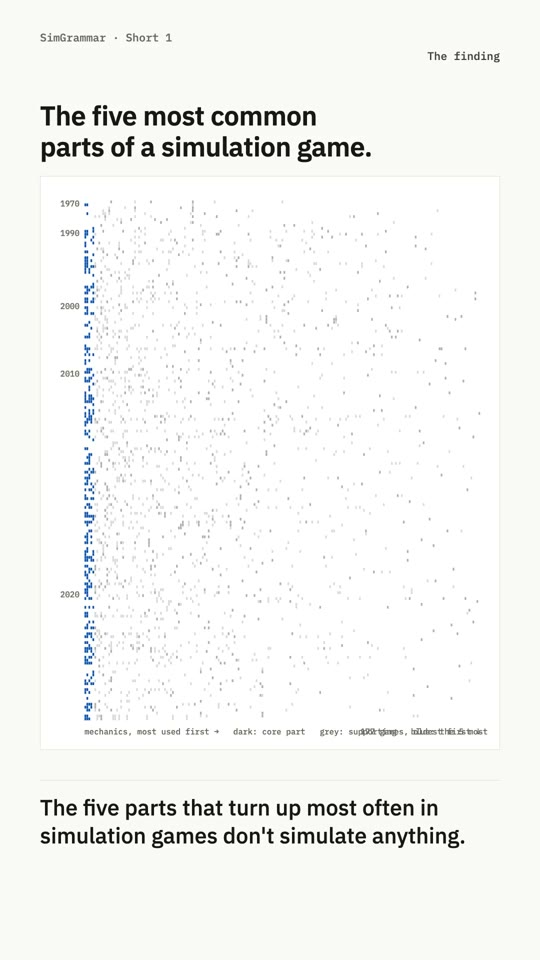 play · 0:38
short 1 0:38 from chapter 1 · episode 1
The five most common parts
The five parts that turn up most often in simulation games don't simulate anything.
transcript
every number checked against the dataset when the episode was renderedread the transcript, scene by scene · 9 scenes
Cold open
Three days after the raid, the cook walks off the job. Click on her and RimWorld tells you why, line by line. Her son died in the fight: minus twenty, for thirty days. The fine meal that was holding her up has worn off. Her mood has been under the break line since the funeral, and today the game rolled the dice [1] [2].
Nobody scripted that. Five separate rules made it happen, and every simulation game is built out of rules like them.
RimWorld, in parts
We've broken 177 simulation games into their parts. RimWorld comes apart into 25 of them, and 7 are core, meaning it would be a different game without them.
The storyteller picks the raid, and spends a threat budget that grows with your wealth. Needs run down and feed mood. Every mood effect is written into memory with a value and an expiry. Mood below a threshold rolls for a breakdown. Bodies are trees of parts that bleed and scar. You rank the jobs, and colonists pick their own work.
A part only counts if it passes four tests. Another designer would recognize it. It does one job. It has levers. And a game could drop it and still run. The storyteller passes: Left 4 Dead's director is the same idea, its levers are the event list and the length of the quiet stretches, and Dwarf Fortress runs without one [3].
Rare parts
Now look at how many other games use each part. The storyteller is in 3 catalog games. Mood breaks in 8. Injuries by body part in 7. Only needs that decay are common, shared by 30 games going back to Little Computer People in 1985.
Three of those rare parts first show up in the catalog in one game, Dwarf Fortress, in 2006: mood breaks, bodies made of parts, and danger that grows with wealth. The earliest storyteller in the catalog comes from Façade, a 2005 interactive drama where a drama manager steers an argument between a married couple toward one of three endings.
The grid
Do that for every game in the catalog. 177 games, from 1968 to 2026, broken into a shared vocabulary of 199 mechanics. Each row is a game. Each column is a mechanic. A dark mark means the part is core.
The average game uses about 11.4 parts. Only 2 mechanics belong to a single game, so almost everything in the vocabulary was worth building more than once.
The most common parts
The five most common parts are the pause button, placing buildings, mod support, a tech tree, and scenario goals. None of them simulates anything. They handle the player: when the world runs, where things go, who can change the rules. Production chains come sixth, the first part on the list that models something in the world.
The pause button is in 47 percent of catalog games, and core in exactly one: Universe Sandbox, where running a solar system faster can change how it ends.
Where identity lives
RimWorld's pattern holds across the catalog. The parts a game calls core are used by a median of 11 catalog games. The parts it calls supporting, by 18. And 84 percent of games have at least one core part that no more than 10 games share.
Six jobs
The parts also do different jobs. In SimCity, crime in each cell is a formula: 128, minus land value, plus density, minus police [4]. The maps hold the city's state. The formulas change it. Pollution dragging down land value connects one system to another. Zoning brings in what you want. The overlays show you what is going on. And disasters and the yearly budget decide when you have to pay attention.
Factorio runs two loops against each other. Production feeds itself: more machines, more research, more machines. Pollution pushes back. It spreads from chunk to chunk, the nests that soak it up send attacks, and the enemies evolve as your total pollution climbs [5] [6].
Oxygen Not Included runs its heat through one rule. Every tile holds an element with a mass and a temperature, and every fifth of a second it trades heat with its neighbours [7]. Insulation, boiling, and overheating machines all fall out of that.
The Sims chooses where your control stops. Sims feed themselves, but paying bills and finding a job need you [8]. Frostpunk shows pacing: the temperature falls on a schedule toward a storm you know is coming [9].
Where genres spend
Count where each genre spends its parts and the genres separate. Life sims put about a third into agents and behavior. Factory games lead with production. Programming games lead with control. Vehicle sims lead with careers and missions, ahead of the physics. And the AI-native games, the ones built on learned models, lead with social relations.
Of the 19701 possible pairs of mechanics, 28 percent have ever shared a catalog game. Later episodes go looking in the gaps.
Close
Try it on a game you love. List its parts, mark the ones it couldn't live without, and look up how many other games use each one. The ones that make it special will probably be rare.
Everything in this video comes from an open dataset, and every number on screen is checked against it each time it's built. Next episode: where these parts came from, and the handful of games that introduced the most of them.