the book · contents
01-same-parts 2,953 words about 13 min
Chapter 1. Same parts
The raid comes at dusk. A letter in the corner of the screen says pirates have landed to the east. You stop the clock, draft the two colonists nearest the door, walk them to the sandbags, and let time run again. The fight takes less than a minute of game time. One pirate gets as far as the doorway before he goes down, and he takes the cook's son with him.
Three days later the cook puts down her knife and walks out of the kitchen. She ignores orders. She wanders past the stockpile and out through the fields while the stew she left burns. Open her needs tab and RimWorld tells you why, one line at a time: her son died, worth −20 to her mood for thirty days; a lavish meal two days ago, worth +12, has since expired; a dozen smaller entries for her bed, her room, and the corpses nobody has hauled away [1]. Her mood has sat below the first of three break thresholds, 35, 20, and 5 percent, since the funeral, and every hour below it carried a chance of a break. Today the roll came up [2].
Nobody wrote that story. A storyteller chose the raid and its timing. The raid's size came from how rich the colony had grown. The shot that killed the son hit a named part of his body. His death wrote an entry into his mother's memory with a value and an expiry date, the entries summed to a mood, and the mood crossed a threshold that rolls for breakdowns. Each of those is a separate rule-system with its own state and its own update rule, and RimWorld's designer chose them for the stories they produce: he describes the game as a "story generator" [3].
An open dataset breaks 177 simulation games into 199 named rule-systems like those, with the sources for each, and this book is built on it.
RimWorld, in parts
The dataset lists 25 mechanics in RimWorld. A mechanic, in this book, is a named rule-system that owns one kind of state and one rule for changing it. Each game marks some of its mechanics as core, meaning the game would be a different game without them. RimWorld has 7:
- a storyteller that picks incidents from a catalog, spending a threat budget derived from colony wealth and the time since the last major event;
- needs that run down (food, rest, recreation, comfort, beauty) and feed each colonist's mood;
- mood breaks, rolled while mood sits below thresholds that personality traits shift;
- memories and thoughts, every mood effect listed with its source and expiry;
- work priorities, a grid of colonists by job types where you rank each job from 1 to 4 and colonists choose for themselves;
- an injury model in which a body is a tree of parts that bleed, scar, get infected, and get replaced;
- threat that scales with wealth, so the richer the colony, the bigger the raids.
The other mechanics support those: crops and spoilage, rooms the game recognizes from their walls and furniture, traits, relationships, fire, permanent death, mod support, and the pause button you pressed when the letter arrived.
The definition has four tests, and a candidate has to pass all of them before it enters the taxonomy. A designer must be able to name it and recognize it in other games. It must be atomic: if it splits into two parts that real games use without each other, it is two mechanics. It must have at least two levers a designer can turn. And a game must be able to drop it and still run. The storyteller passes: Left 4 Dead's director and RimWorld's three storytellers are recognizably the same thing [4], its levers include the incident catalog and the length of the quiet stretches, and a colony sim can run without one, as Dwarf Fortress does.
Rare parts
Count how many other games in the catalog use each of RimWorld's core mechanics. The storyteller appears in 3 catalog games, work priorities in 6, the injury model in 7, mood breaks in 8, scaling threat in 9, and itemized memories in 10. Six of the seven are rare. The seventh, needs that decay, is shared by 30 games, going back to Little Computer People in 1985.
The rare six have traceable origins. Three of them, mood breaks, bodies made of parts, and danger that grows with wealth, first appear in the catalog in the same game, Dwarf Fortress, released in 2006. Dwarf Fortress is where the three arrived together in a colony sim, and RimWorld's record names it as an influence. The catalog's earliest storyteller is older and comes from somewhere else: Façade, a 2005 interactive drama in which a drama manager picks the next beat of an argument between a married couple, Grace and Trip, toward one of three endings. RimWorld's core puts together a device the catalog first records in a narrative experiment, three systems that arrived together in Dwarf Fortress, and the needs of the life sims, all driven through a work grid.
The pattern holds across the catalog. The mechanics games mark as core are used by a median of 11 catalog games; the ones they mark as supporting, by a median of 18. And 84 percent of games have at least one core mechanic that no more than 10 catalog games use.
How much of a game is core
Games differ in how much of themselves they mark as core. The median catalog game marks 3 of its mechanics as core. Factorio and Dwarf Fortress mark 8, the most in the catalog, and RimWorld and Dyson Sphere Program come next with seven. At the other end, 5 games mark a single mechanic. Townscaper and Tiny Glade mark only the tool that turns rough shapes into detailed buildings (chapter 4). PowerWash Simulator marks its four nozzles of different power and spray width and its soaps matched to surfaces. X-Plane marks its flight model, which splits wings, control surfaces, and propellers into small elements and computes the forces on each [5].
Zoning is core in all 10 games that use it, and 7 mechanics used by at least three games are core everywhere they appear, among them the match engine of sports management games and diagnosis in hospital games. Fire spreads in 18 catalog games, goods sit in limited storage in 19, and loans charge interest in 14, and no game marks any of the three as core. Across the vocabulary, 33 mechanics in use are never core in any game.
The grid
Do the same for every game in the catalog. The dataset decomposes 177 games, from 1968 to 2026, into a shared vocabulary of 199 mechanics. Each game lists the mechanics it uses, marks the core ones, and adds a note on how it implements each. Across the catalog there are 2016 such uses; the average game is built from 11.4 mechanics, and the median game from 11.
Almost every mechanic recurs. Only 2 of the 199 appear in a single title, so a mechanic in this vocabulary is something several designers found worth building. The two exceptions are the weighted network of policies, statistics, and voter groups in Democracy 4, described in chapter 2, and the soft-body vehicles of BeamNG.drive, described in chapter 3.
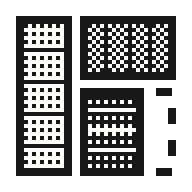
The figure draws every use at once. Each row is a game and each column a mechanic; each mark is a game using a mechanic, filled where the mechanic is core.

Figure: Every use: the catalog as a grid. Each square is one game using one mechanic: 592 core uses (dark) and 1424 supporting uses (light). Rows are grouped into the clusters of chapter 4 and columns into mechanic families. Hover or tap to read a cell; reorder rows by release year or columns by first use. Interactive version: https://sim.yohei.me/#fig-matrix
A row is one game's recipe. A column is one mechanic's career: the year it first appears, how fast it spread, and which kinds of games took it up. A few columns are nearly full and most are nearly empty.
The most common parts
The five mechanics that the most catalog games use are the pause button, building placement, mod support, a tech tree, and scenario goals. None of the five models anything in the world being simulated. They decide when the world runs, where the player puts things, who may change the rules, and what the player is working toward. Production chains come sixth and are the first mechanic on the list that models a process: ore into plates, plates into gears, grain into flour into bread.
The pause button leads, present in 47 percent of catalog games. The one game where it is core is Universe Sandbox, a space sandbox where the speed you choose changes the result: the simulation runs from real time to years per second, larger time steps trade away accuracy, and a fast run of a solar system can end differently from a slow one. Real time with a pause is also the catalog's most common way to handle time, at 82 games against 54 in pure real time and 20 turn-based. Fast-forward runs every other system faster, so the late-game slowdown players complain about in colony and city games is the cost of every computed path and every growing crop, showing up as the top speed the machine can reach. Chapter 6 treats compute as one of five ceilings on what a mechanic can be.
Building placement is the exception among the five. It is core in 18 games, the city builders and construction games where placing things is most of what the player does. The other four are nearly always supporting parts. Mod support is core in 2 games: in Garry's Mod community game modes became the main way people play, and Arma 3 gets much of its life from community scenarios and mods.
One name, many rules
A mechanic's name covers a family of rules. The record defines the family and lists its levers, the settings a designer can turn; each game's note in the grid says where that game sets them.
Needs that decay are core in 17 of the 30 catalog games that use them. The record defines them as a set of bounded stocks held by each agent, each falling at its own rate and refilled by particular actions or objects, with low values feeding mood, the choice of the next action, health, or death. Its levers are the number of needs and which ones can kill, the decay rates and what modifies them, how much an action restores, the thresholds that trigger warnings or breakdowns, and whether the player sees meters or only behavior.
The games set those levers far apart. Little Computer People's resident grows hungry and thirsty between the player's deliveries and eventually looks sick. Tamagotchi drains its hunger and happiness meters, shown as hearts, in real time. In Creatures, drives such as hunger and tiredness are concentrations in a simulated biochemistry. The Sims shipped in 2000 with eight motives, among them Comfort and Room [6]; The Sims 3 and The Sims 4 track six [7]. Prison Architect gives each prisoner about 21 needs, including freedom, family, privacy, and spirituality, each charging from 1 to 10 until a full need triggers its side effect [8]. Papers, Please gives its needs to the player's family: its members get worse on days when food, heat, or other necessities go unpaid.
The record lists what goes wrong at the extremes. Too many needs turn play into chore management. Decay rates that are the same for everyone make every agent alike. Fast decay with slow restoration produces death spirals early in a run, and needs the player cannot see read as random misbehavior. Its dynamics include rush hours: needs that decay in step send everyone to the kitchen, the beds, and the bathroom at the same time.
A tech tree is core in only 12 of its 43 games. The record defines it as a directed graph of technologies, each with prerequisites, a cost, and the things it unlocks; research output accumulates toward the selected node until the cost is paid. Its levers are the shape of the graph, the cost curve, whether branches exclude each other, repeatable technologies for the late game, how much of the future the player can see, and what pays for research.
What pays for research differs from game to game. Theme Park, RollerCoaster Tycoon, and Zoo Tycoon pay with money. Factorio's labs consume science packs, so research becomes something the factory produces, and Dyson Sphere Program's labs consume matrix cubes in a different mix for each technology. Satisfactory and shapez 2 unlock their next tier when the player delivers enough parts or shapes. Plague Inc. spends DNA points across three trees, for transmission, symptoms, and abilities. In Minecraft material tiers gate progression: iron tools mine diamonds and diamond tools mine obsidian. The Farmer Was Replaced, a programming game, uses its tree to unlock the language the player writes in, from loops and variables to functions, lists, and dictionaries [9].
The tech tree's record lists a dominant path that every player follows, late technologies that do nothing useful, so that some players dismantle their labs to save upkeep, final technologies strong enough to end a game quickly, and random draws that frustrate players who plan.
What the names are for
Naming parts lets you compare games that look nothing alike. RimWorld and The Sims sell to different players and get reviewed in different places. In the grid they share needs that decay, personality traits, relationships, skills, decoration that people respond to, and characters that choose their own next action by scoring what they need. A designer who knows that can borrow across the genre line deliberately, and chapter 4 shows that grouping games by their parts puts the two in the same family more often than not.
Names also show what has not been tried. A vocabulary of 199 mechanics allows 19701 possible pairs, and only 28 percent of those pairs occur together in even one catalog game. Some combinations are empty because they make no sense; a flight simulator has no use for building placement. Others are empty because nobody has built them, and chapter 9 walks through the ones where both mechanics are common.
And names make questions about AI answerable. A language model that writes dialogue changes a different column of the grid from a learned physics model or a planner that routes a city's traffic. Chapters 7 and 8 trace each technique in the dataset to the mechanics it affects. Of the ten most widely used mechanics, 6 have no technique in the dataset pointed at them.
Names still missing
The vocabulary grows when a game has a rule the taxonomy cannot name. The agents that built the dataset filed each such rule as a proposal in their run's record, with a definition and usually the games that use it, for a maintainer to accept or reject. The run log holds 65 proposals for new mechanics, and 28 of the proposed ids are mechanics today. Advertising spend from Lemonade Stand, negotiation over wages and fees, and the late-game megaprojects that absorb a factory's output all entered this way.
Others are still proposals. Caesar III's angry gods have no mechanic: the proposal describes gods with mood stocks raised by temples and festivals and lowered by neglect, whose thresholds grant blessings or trigger curses, and it notes that the existing god powers are cast by the player, so the rule is a different one. The Oregon Trail's trip west, a party moving along a route of landmarks at a pace and ration level the player sets, is split today across survival meters, turns, and random events. Construction that waits for materials and labor to arrive at the site, as in Banished, Manor Lords, and Workers & Resources: Soviet Republic, is split across hauling and production chains. Civilization's cities, each working a few nearby map tiles for food, production, and trade, have no name of their own either.
Per-turn action points, the budget of moves a tactical game gives each unit, would pass the four tests once the catalog holds tactical simulations. A dream or memory sequence drawn by a world model from a game's state, without changing that state, appears in no shipped game, so the proposal records that it probably fails the first test: no designer can yet recognize it in other games.
Exercise: decompose a game
Pick a simulation game you know well. It does not have to be in the catalog.
- List its mechanics, using the catalog's names where they fit (the mechanic list at sim.yohei.me). Ten to fifteen is typical.
- Mark the core ones, the mechanics without which it would be a different game. Most games have only a few.
- For each core mechanic, guess how many catalog games use it, then look it up. The parts you think of as the game's signature are probably rarer than you guessed, and the parts you never think about are probably among the most common.
- Remove one core mechanic and describe the game that is left. Then add one rare mechanic from another game's core and describe that game.
Chapter 2 sorts the vocabulary by the job each mechanic does: holding state, changing it, connecting systems, taking in the player's intent, showing what is happening, and deciding when the player has to look.
Sources
[1] RimWorld Wiki contributors (2026). Thoughts. RimWorld Wiki https://rimworldwiki.com/wiki/Thoughts
[2] RimWorld Wiki contributors (2026). Mental break. RimWorld Wiki https://rimworldwiki.com/wiki/Mental_break
[3] Wikipedia contributors (2026). RimWorld. Wikipedia https://en.wikipedia.org/wiki/RimWorld
[4] Michael Booth (2009-10). The AI Systems of Left 4 Dead. Artificial Intelligence and Interactive Digital Entertainment Conference (AIIDE) 2009, Stanford https://cdn.fastly.steamstatic.com/apps/valve/2009/ai_systems_of_l4d_mike_booth.pdf
[5] Wikipedia contributors (2026). X-Plane (simulator). Wikipedia https://en.wikipedia.org/wiki/X-Plane_(simulator)
[6] Wikipedia contributors (2026). The Sims (video game). Wikipedia https://en.wikipedia.org/wiki/The_Sims_(video_game)
[7] The Sims Wiki contributors (2026). Motive. The Sims Wiki (Fandom) https://sims.fandom.com/wiki/Motive
[8] Prison Architect Wiki contributors (2026). Needs. Prison Architect Wiki (Fandom) https://prison-architect.fandom.com/wiki/Needs
[9] The Farmer Was Replaced Wiki contributors (2026). Unlocks. The Farmer Was Replaced Wiki https://thefarmerwasreplaced.wiki.gg/wiki/Unlocks
Dataset dfde7895aa6d.
 Building placement
 Fire spread
 God powers
 Memories and thoughts
 Negotiation
 Personality traits
 Production chains
 Spoilage
 Survival meters
 Tech tree
 Work priorities
 Zoning