episode 5 of 12 7:29 9 scenes book chapter 6
The five ceilings
Five limits on simulation games: content made by hand, ticks per second, what a player can follow, the same inputs giving the same world, and believable minds. Lifting one usually spends another, and the cost of authoring is falling fastest.
 play · 7:29
in the book
the chapter this episode followschapter 6 3,943 words about 17 min 64 records
Five ceilings
In this chapter: Content made by hand · Ticks per second · What a player can follow · Same inputs, same world · Minds made of formulas · Lifting one ceiling spends another · The ceilings move at different speeds · Exercise: find the ceiling.
games in this episode
15 on screen, in order of appearance

Crusader Kings III
A character-driven grand strategy game in which the player rules as successive heads of a medieval dynasty from 867 or later to 1453, managing traits, stress, vassal opinion, marriages, and succession across a map of feudal titles.
on screen 1:29




SimCity (2013)
A SimCity reboot built on the agent-based GlassBox engine, in which agents carry workers, power, water, and goods between buildings and small cities share a region over an always-online connection.
on screen 3:20
Dwarf Fortress
A colony sim in which the player directs a fortress of autonomous dwarves inside a procedurally generated world whose history, geology, fluids, bodies, and minds are all simulated.


RollerCoaster Tycoon
An amusement park management game in which the player builds rides and custom coasters piece by piece, rated for excitement, intensity, and nausea, to satisfy guests with individual preferences and meet scenario goals.
on screen 4:59


Generative Agents (Smallville)
A research sandbox in which 25 language-model agents in a Sims-like town keep natural-language memory streams, reflect, and plan their days, producing unscripted information spread and social coordination.
Cities: Skylines
A city builder in which road-following zones, agent citizens who route to work along computed paths, district policies, and player-drawn transit lines make traffic flow the central design problem.
on screen 6:34
Infinite Craft
A browser crafting game in which combining any two elements yields a new element whose name and emoji a language model generates on first request and a shared database then fixes for all players.
on screen 6:44
mechanics in this episode
9 named in the narration, 17 more on screen
Crop cultivation
Planted crops progress through growth stages over days or seasons depending on water, soil, and season, then are harvested.
on screen 0:41

Smart objects
Objects advertise the need satisfaction they offer, and agents query nearby objects to decide what to do.

Dilemma cards
Discrete choice events present a situation with a few options that each shift meters, values, or flags in tradeoff.
on screen 1:29

Social exchanges
Discrete social moves such as flirt, insult, or apologize have preconditions on social state and norms, and they update relationships.
on screen 2:01

Storyteller director
A director AI chooses which events to fire and when, pacing them by a model of tension and the current state.
on screen 2:01

Pause and speed control
The player pauses the simulation and switches between speed multipliers, trading attention against elapsed game time.
on screen 2:46

Falling-sand materials
Every pixel or cell holds a material whose class rule makes it fall, flow, or rise by swapping with neighbors, with reactions layered on top.
on screen 3:02

Memories and thoughts
Events create itemized, time-limited mood modifiers or lasting memories that shape later behavior.
on screen 5:18

Traffic congestion
Trips route over a capacitated network; volume beyond capacity raises travel time and delays services and deliveries.
on screen 6:38
also on screen · 17 mechanics















shorts from this episode
1 · under a minute each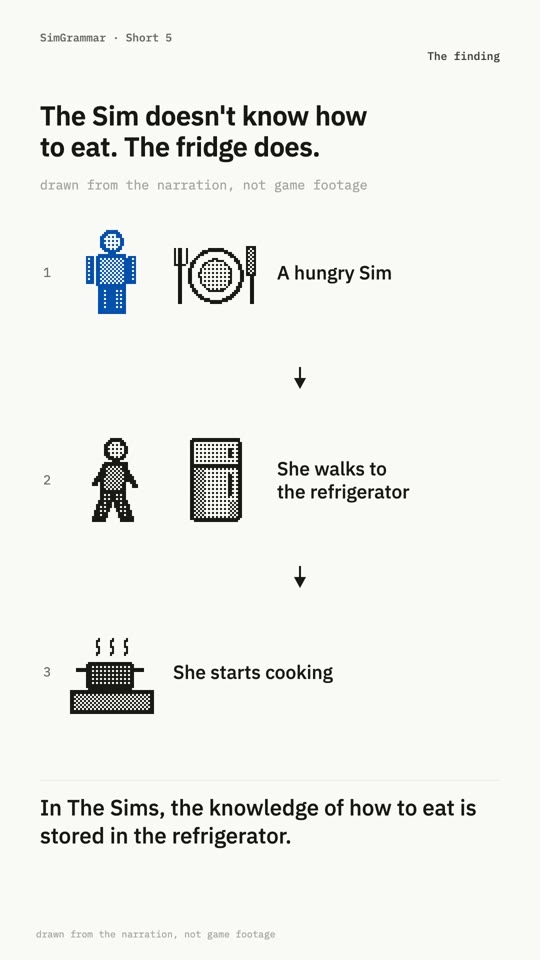 play · 0:36
short 5 0:36 from chapter 6 · episode 5
The refrigerator knows
In The Sims, the knowledge of how to eat is stored in the refrigerator.
transcript
every number checked against the dataset when the episode was renderedread the transcript, scene by scene · 9 scenes
Cold open
Your Sim is hungry. You buy a refrigerator, put it in the kitchen, and she walks straight to it. She didn't know how to use a refrigerator. The refrigerator told her.
Behavior that lives in objects
In The Sims, a Sim carries no knowledge of how to use anything. Each object advertises what it offers. A refrigerator advertises Hunger, a bed advertises Energy. When a Sim decides what to do, she collects the advertisements of everything she can reach, weighs them by what she needs and how far she'd have to walk, and picks one. The object supplies the rest: the script she runs and the animations she plays [1].
That's why The Sims could keep growing. A new object brought new behavior without any change to the Sims, so each expansion pack extended what they could do by adding things to buy. The base game shipped with more than 150 objects. Every one of them was designed, scripted, animated, and tuned by hand. The dataset scores the mechanic 4 out of 5 for authoring cost. It brought its own bugs, too. Tune one object's advertisement too high and Sims queue for it whatever they need. Break an object that keeps advertising and Sims try to use it again and again.
Authoring cost is one of five limits that have shaped what simulation mechanics can be. The others are the compute a machine can spend each tick, how much hidden state a player can follow, the need for the same inputs to produce the same world, and how believable a mind made of formulas can be.
Content made by hand
The two mechanics that eat the most content, by the dataset's scores, are both about story: chains of triggered events, and dilemma cards. In Crusader Kings III an event fires from a birth, a death, or a yearly check, and schedules its own follow-up months later, so a rival's illness becomes a succession fight and then a war [2]. Every branch is written by hand, and players who've played enough start seeing the same chains. Reigns runs a kingdom on four meters and a deck of cards, and after enough reigns you answer from memory.
Open input hits the same ceiling. Façade, from 2005, let you type anything to a married couple at dinner. Behind the text box, each sentence was mapped to one of a small set of social moves, and a drama manager picked the next scene from a library its authors had written. One analysis counted 30 kinds of speech act and 27 story beats [3].
The rater who scored every mechanic also judged how open each one is to AI, and the two judgments line up. The mechanics that cost the most to author are the ones rated most open to generative models. It's one rater, so that's a consistent reading, not a finding twice confirmed.
Ticks per second
Every real-time simulation advances its whole world many times a second while drawing the screen. When fast-forward can't keep up late in a game, you're seeing every other system's cost at once: paths recomputed after you edit the map, heat moving between thousands of cells, a sky full of logistics robots in a big factory. The records list each of those as a failure mode.
Physics and materials is the costliest family to compute: falling sand, fluids and gases, destruction down to the voxel. They're also among the rarest. Falling-sand materials, where every pixel is a material with its own rules, appear in 2 catalog games. Noita is one of them, and it's a 2D game.
The ceiling explains city builders too. Most simulate their people as totals with a few visible faces. When SimCity in 2013 switched to agents that carry workers, water, and goods between buildings, its cities were smaller than earlier games' by design. Dwarf Fortress moves some of its cost to before you start: it can simulate thousands of years of a world's history while generating it, which takes a long time and leaves you with a very large save.
What a player can follow
The third ceiling was the last episode. On the dataset's scores, the mechanics that produce the most variety are the hardest to read, so every system a game connects to the others needs a way to be understood: an overlay, a tooltip, an inspection panel. Each one costs design time and screen space.
Same inputs, same world
Replays, bug reports from save files, leaderboards, and lockstep multiplayer all depend on the same inputs producing exactly the same world. In lockstep play, every player's machine runs the whole simulation and only inputs cross the network. Factorio is built around it. Its items move in exact, discrete steps, a belt carrying 15, 30, 45, or 60 items a second depending on its tier, so every machine in a multiplayer game computes the identical factory [4].
That requirement has kept learned models out of the parts of games that decide what happens. The dataset sorts every AI technique that can run during play by what it does to reproducibility. Some break it outright. More can be made reproducible by fixing a seed, caching an answer, or logging what the model said. Episode 10 is about what happens when they meet a game that depends on it.
Minds made of formulas
The fifth ceiling is believability. Many simulated people choose by scoring their options against their needs and picking the best. It's cheap and readable, and it fails in recognizable ways: two options score the same and a character flips between them, or one need drowns out everything else. Designers worked within it in a few ways. RollerCoaster Tycoon made many shallow guests, each with some money, a taste for intensity, a tolerance for nausea, and a stream of one-line thoughts [5]. RimWorld and Dwarf Fortress made a few deep characters with long memories and bodies that remember every wound.
Creatures, in 1996, tried to grow minds instead. Each Norn had a neural network for a brain, a simulated body chemistry, and a genome that built both, and it learned from what reduced its drives. Players bred and traded mutants online. Learning creatures appear in 4 catalog games.
In 2023 a research team put 25 language-model agents in a town modeled on The Sims. Each kept a written memory, reflected on it, and planned its day. Told that one of them wanted to throw a Valentine's Day party, the town spread the news by talking: over two game days, 13 of the 25 heard and five came. Running it cost thousands of dollars in API credits [6]. They held conversations no Sim can hold. Every choice they make costs money while you play, and none of them can be replayed from the inputs.
Lifting one ceiling spends another
Smart objects let The Sims add behavior without touching its people, and every behavior became something to author. Individual cars let Cities: Skylines show you a jam, and cost compute and a traffic model players couldn't read. Generative Agents bought conversation with inference and reproducibility. Infinite Craft kept determinism by caching every answer.
Close
The five ceilings aren't moving together. Authoring cost is giving way fastest: generated assets, learned motion, and language characters have all shipped. Compute is giving way mostly in graphics. Neural upscaling and frame generation are the one AI technique in the dataset that's standard in shipped games, and they never touch what the simulation decides. Learned replacements for physics, fluids, and weather are still prototypes and research.
Next episode: what AI has shipped in games so far, starting in 2019 with a text adventure that had no rules at all, just a language model continuing the story.